Thursday, June 13, 2013

NOTES ON GIANNI SCHICCHI (buy tickets!)


Giacomo Puccini (1858-1924)
OPERA PROJECT COLUMBUS PRESENTS GIANNI SCHICCHI THIS WEEKEND: 

www.operaprojectcolumbus.org


Sat 8 pm Sunday 3 pm
Jewsih Community Center of Columbus
tix at the door

NOTES ON GIANNI SCHICCHI
   
Christopher Purdy

Giacomo Puccini (1858-1924) spent some of his time writing the wonderful operas we love today, among them: Madama Butterfly, La boheme, Tosca and Gianni Schicchi,  and spent most of his time chasing down subjects for his next opera, arguing with librettists, placating singers, supervising rehearsals, and trying to stay clear of his bad tempered wife, Elvira.

Dante
Like Verdi before him and Mozart before him, Puccini was never satisfied until he had found a new subject for an opera. Later in his career he found three subjects. He planned an evening of three one -act operas and called the grouping Il trittico.
He completed a one act grande-guignol shocker, Il tabarro, (The Cloak) and the story of a young woman who bears a child she is forced to give up, and made to enter a convent: Suor Angelica.  Gianni Schicchi , Puccini’s only comedy,  was the only one of the three to achieve success in the composer’s life time. It was the last opera Puccini completed.

Puccini’s librettist for Suor Angelica and Gianni Schicchi was Giovacchino Forzano (1884-1970). Forzano had studied singing and medicine before turning to journalism. He continued his career as a stage director at La Scala and as a playwright. For Gianni Schicchi ,  the writer turned a few lines from Dante’s Divina Commedia. The story of Gianni Schicchi is expanded upon in Commentary on the Divine Comedy by an Anonymous Florentine of the 14th century. The subject didn’t immediately interest Puccini, who thought the plot too complicated.

Here’s the deal: In 13th century Florence, old Buoso Donati has just died. A rumor has
Giuseppe DeLuca as Figaro. He was the first Gianni Schicchi
been going around that Buoso has left his entire estate, including his house, his mule (la mula) and the mills at Signa (I mulini di Signa) to the local monks. This will never do. Buoso’s family searches frantically for the will (‘il testamento’) and find the rumors to be true. Young Rinuccio suggests calling on Gianni Schicchi, a wily soul of lower classes who is nevertheless the smartest guy in the room. The fact that Rinuccio is in love with Schicchi’s daughter Lauretta doesn’t hurt. The family is outraged. They want no part of this low rent upstart and his daughter.


Rincuccio prevails and Schicchi and Lauretta arrive. Gianni has as little use for the Donati as they for him. Nevertheless he has Buoso’s body taken out, dresses in Buoso’s clothes, summons the lawyers and dictates Buoso Donati’s new will leaving the mills at Signa, the house and the mule to…Gianni Schicchi. Lauretta and Rinuccio chirp away romantically. The relatives loot everything they can carry and Gianni Schicchi, consigned to hell by Dante, asks for our applause.

Work on Il trittico began around the beginning of World War I. Puccini’s recent opera The Girl of the Golden West, was written for the Metropolitan in New York. That premiere, with Caruso, Toscanini and Emmy Destinn had been a success, but as the years went by critics carped this was not Puccini at his best. World War I made a production of his newest effort, La rondine difficult. Domestic problems and supervising productions of his operas in Europe and America kept Puccini pre -occupied. Finally the Met asked him for another new opera, and wound up with three.
Florence Easton the first Lauretta

Opening night in New York, December 14, 1918, was THE musical event of the season, as The Girl had been eight years earlier. No expense was spared. The first casts included some of opera’s  greatest names: Giuseppe de Luca, Claudia Muzio, Geraldine Farrar and Luigi Montesano. British soprano Florence Easton as Lauretta made O mio babbino caro an instant hit. De Luca, adored by New Yorkers, delighted with his Gianni Schicchi. The audience laughed and applauded the wily Gianni and the horrible Donati relatives. Il tabarro and Suor Angelica were another story. Neither rose above a success d’estime. Not even Farrar, opera’s most glamorous soprano,  could save Puccini’s doomed nun. Puccini was heard to say, “La Farrar has lost her voice!” Il tabarro was thought too dark and heavy. The opening night audience, having endured two operas they didn’t like, may have lost hope until the curtain rose on the dead Buoso Donati, his awful relatives, a pair of young lovers and a smart and shifty title character.


The years have been good to Il tabarro and Suor Angelica. Gianni Schicchi was an
Geraldine Farrar the first Suor Angelca
immediate hit, needing no one’s help. O mio babbino caro was encored. De Luca was cheered to the walls.  The New York Times feared critic W.J. Henderson was polite to Farrar and Muzio and called Gianni Schicchi “one of the most delightful bits ever put on the Metropolitan stage.” Puccini, womanizer he was, was one of very few men who never cared for Geraldine Farrar,  but the success of Gianni Schicchi didn’t surprise him. He turned his attention to the Italian premier scheduled for later that December, and went to work on his opera Turandot. But that is another story. 

Gianni Schicchi Diary pt. 12


This is the Spanish tenor Hipolito Lazaro (1887-1974).  Puccini was a big fan. He tried to get Lazaro for Turandot but senor tenore anted too much money. La Scala wouldn't pay it. I love Lazaro's ego: "Caruso is my understudy!" he would cry. As if.


Late rehearsals often go to shit. Here's the combination. Italian conductor leading a newly formed band, mostly young people. A cramped performance space. Lights being run for the first time. An antsy 11 year old. Balance issues. Oh, and did I mention we were told a tornado was en route. If you have opera, who needs a tornado? We didn't get one.

We did get, against the odds, a wonderful tech run last night. I sent out a few notes. None to Gianni himself because there's nothing I can add to his performance. Lauretta isn't too sweet and it just bitchy enough. Bitchy is more interesting any day. Simone practically re-staged the finale, thanks be to God, lugging the very table off stage with the other loot. Nella and Ciesca don't have enough to do vocally, but on stage throughout they are gorgeous. Zita...how this lady known for her equanimity can be such a meany on stage is a testament to art. Rinuccio is just horny enough without being a pig. I myself have no objections to horniness, distant memory it may be, but there's a fine line to vulgarity. I hate vulgarity in opera. Did I tell you about the production of Un ballo in mashera in Spain...where the curtain opened on a row of men sitting on toilets with their pants down. One critic was smart enough to say, "The beasts didn't even wipe their bottoms!"


The Maestro just phoned. He was full of praise for the singers and orchestra. His greatest concern  balance. It was good last night and it will be better with an audience.

I e mailed my buddy Charles Long abut this production and about our Schicchi in particular. Charles was a New York City Opera baritone with a strong regional carer through the 1980s. He's just published a memoir called Adventures in the Scream Trade. Anyone wanting a career in opera needs to read this book. Go to confession first, if you're Catholic because you are going to die laughing. I discuss the book elsewhere on this blog. Do a search. Charles and I were lamenting the shitti-ness of some of the opera business-getting in always about who you  know and often about who you shtup (and I'd get it in writing) I needed his advice about how to help singers up the next step. Read his book.

Final dress tonight. Two complete runs. Stage the curtain call in between. And so to bed.

Wednesday, June 12, 2013

Gianni Schicchi Diary pt. 11

I must admit last night had me nervous. It was the first rehearsal with orchestra. With the band on stage, would the singers even be heard? Would the Maestro freak that the staging doesn't keep in line line of the singer's vision?

No worries. All sounded great. The reduced orchestration is fine for the hall. I'm still moved when in the midst of the yammer Puccini cushions all with the magnificent 'babbino caro' melody, and I was thrilled hearing it last night. One thing I'm grateful for. The music I loved fifty years ago I love still, and it always sounds new and wonderful to me.  When you work up close and personal with any music you thought
 you knew so well, you always get to hear and learn new things. The Maestro discussing context has me realizing once and for all that fine composers always put stage directions in the music. In the music.
I never knew what singers like Domingo and Caballe meant when they insisted that stage directions are in the score. Now I know better. The old words v. music argument is baloney. They work together. One does not function without the other--obviously--but when you really listen for this fusion the score tells you what to do.

Met with the lighting designer last night. Previously when I'd ask for lighting I'd be told you want 'em on or off? Not here. This fella has lit GS before and has often worked in our space. His knowledge and manner were very re- assuring.

La Scala, Milan-full house. If they can do it so can OPC
Tonight is the last time I'll be able to impose changes in staging (Ethel Merman used to day, Call me Miss Birdseye, honey. I'm frozen in.) The family will wait in the front of house and begin moaning and wailing there. Gherardino will fetch them as before. (He's the only one of us all who can really run!) I want the cast to be onstage-apron is fine-at the first 'Povero Buoso!" Gherardino and Rinuccio will fetch the Notary, Gubbio and Pinellino. The front and center entrance I wanted won't work now. They will walk straight back of stage and swing down to the table. Rino will  usher them forth!

AND

For the very top of the show. The Maestro will enter and bow. Before the downbeat, Nella,  Gherardo, Gherardino will come in form stage right...Gherardo will be carrying a huge bunch of flowers (you saw them last night-wonderfully hideous) They will go over to kiss Buoso and realize he's dead. Then the pantomime and sending Gheardino out. Gherardino's exit is the downbeat.)


(It's been a rough week. A dear friend died of cancer on Monday. The next day another phoned to say she's just been diagnosed. A third friend has been struggling with cancer for the past year. I'm grateful to be surrounded by Puccini and all this excellence even while texts messages beep in from hospitals. )

He may just buy a seat to Gianni Schicchi
I have no idea about ticket sales. I prefer not to know. I have enough to worry about. But with all the fine musicianship in this town it would be shame not to have two filled houses. During all the CSO troubles a few years ago I went on air and said-me being me-that the audience has a responsibility, too. It's fine to say "Oh, yes, it's great to have a _____(symphony, opera, ballet, chamber orchestra, museum, fill in the blank)" but bottoms in seats and drachmas spent at the box office are better than lip service.
  
It's long been my experience that rehearsals seldom yield believable performances. But once the curtain goes up, the characters are there to savor. I've never seen a strike out in this respect, and I won't now. And I have a new job back stage with a walkie-talkie, shortening my life!

Tuesday, June 11, 2013

Gianni Schicchi Diary pt. 10


Giuditta Pasta 1797-1865

Getting ready to produce a slew of radio shows including a writer's round table and a chat show this Friday about summer day trips to museums (like I would know),  I was pleased when the mail brought my Father's Day present, the new recording of Bellini's Norma with Cecilia Bartoli.. Loud is the gnashing of teeth among the informed over a lyric mezzo attacking this opera. They forget, Giuditta Pasta, the first Norma,  was herself probably a lyric mezzo. Descriptions of her singing-she died 150 years ago-note a shrill and incomplete technique, many notes missing-especially in the middle of the voice-and an astonishing musicianship and presence. Bartoli's voice is lovely and complete. No problems. She does not sing Norma-as-Amazon but Norma, suffering mother and discarded wife. So far, tenor John Osborn is too soft grained for my idea of Pollione. But the recording engineers didn't ask me for ideas, now did they?

I guess I digressed, huh?

Last night. First night in the hall. We had our indispensable pianist making music on an electric keyboard. He was sweet and firm with out Gherardino leading me to think that his future Father's Days will be a love fest.Our three pianists hear things in this score I've never imagined, and I'm old enough to be-well, their fathers.

(I need to keep Gherardino occupied on stage)

We had a carpet, a couch, nice stage dressing, some furniture set up by 7 p.m. when the onstage festivities began. I have almost no aesthetic sense. I drive a shit box car and live in thrift shop clothes. I've worn the same coat for thirty years. I could buy a new coat ad better clothes. Am I naked? No. (God is merciful) With the money I save I can buy Cecilia Bartoli in Norma. That said, I'm not one to judge the look of the sets and props. All seemed attractive and functional. There were some inevitable traffic jams onstage. Even with much more space  than in rehearsal, the tendency is still to bunch up.That will pass.

Spinellocchio's sweet bumbling was a nice surprise and a job well done. I need to make better use of  Nella and Ciesca-both great looking and sounding women.

I can't explain to the cast how to really react to one another without them clearly understanding the words being sung to them and the responses Puccini/Forzano has them deliver. In this opera  it is more important to be present when you have nothing to sing. Edward Downes told me that Callas was impressive while singing but incredible when onstage listening and watching.

Simone is an inventive fellow coming up with some good stage business and Zita has the Callas message pretty down. I love that, when an artist takes the role and the direction and then goes. That, plus listening and watching in character is what separates the singers from the artists.That and coloring the words. One of my favorite examples of immediately setting a mood with a few notes comes from Lotte Lehmann's performance of Seit ich ihn gesehn, the first lied in Schumann's Fraunenliebe und-leben


She creates a mood, the wonder of a young woman in love for the first time, just with the first intake of breath. We aren't used to this level of personal communication today. We've all been diluted by too much information...things that matter are harder to discern. Schumann got it and so did Lehmann. The Schicchi cast is getting there,.

Orchestra tonight. 

Monday, June 10, 2013

Gianni Schicchi Diary pt. 9

Frank Corsaro
Experience tells me that there is at least one day in any rehearsal period where people are pissy to the extreme. I was not in a great mood this past Saturday. I had expected the entire cast for the first time, and we got very close I must say, only one absence. That in fact was the closest we've had to the complete cast since rehearsals began in mid-May. And yes, I'm just being a culo about this, but sometimes being so is necessary and fun. Almost every one is off book, and Saturday we did have a fine pianist. She claimed to be sight reading. I'll tell you, the general level of musicianship in this town is very high.

Our Gherardino was present. I have to make more use of him on stage. The trick is to keep him busy but not have him upstage the show. Adorable kids can do that, without meaning to.
Tito Gobbi, a great Schicchi shown here as Scarpia
It serves no one to keep an 8 year old unoccupied for long period of time. He opens the show, and has the business and two lines dictated by Puccini and Forzano.

He hadn't been able to count his line properly. (I can't either)  Too excited. The Maestro, as I knew he would, worked patiently and in a matter-of fact way. No dippy shit some adults use when working with kids. Luckily, Gherardino seems very well adjusted and he enjoyed the extra rehearsal.

In short, I as the only one of Saturday who seemed pissy.

Here's a magnificent distraction. The great Tito Gobbi (1913-1984) on Italian television in the 50s. There were many greater voices. Few greater artists. Find out more about him.


Tonight please God we will have the entire cast for the very very very first time. Its just us family at the Jewish Center. I'm told there'll be an electric piano, and one of our regular-highly gifted pianists. This will be the first time cast works in the space. We have worked in quite the cramped quarters prior to tonight. Tonight well be about starting and stopping for physical readjustments to the space. I also have to insure that all can see the Maestro and vice versa. Is a mother's work never done or what?


I wish I had the one one hundreth talent of the great Frank Corsaro (years ago I was lucky to be in the same
ROOM with Frank Corsaro, and if you don't know him look him up) Corsaro would demand very intricate stage business and if the singers complained he would say, Really ? Well,  you have a problem then, don't you? This from a guy who directed Tennessee Williams and Bette Davis at their drunken worst and told them both to fuck off, more than once. You gotta love a guy like this . By the way, if you're singer/performer, .or anyone else reading this blog, you should run not walk to any library and read Corsaro's book, Maverick..


 (I know this is too long. There's a 7 minute abridgement on youtube, can't be embedded. But go find it)

Also tonight, props, linens, the couch and the screen, etc. I don't know what the hell they want the screen for but Linda will schlep along in her van, God love her.

Stop- start. Moves in the space. See the conductor-who will be absent. That's tonight. Tomorrow we have Himself and the orchestra. And the shit may fly. Stay tuned.

Friday, June 07, 2013

Gianni Schicchi Diary pt. 8


Puccini in 1917

I sat there last night in this dingy church basement with a crummy piano and I listened to our cast sing this show for the 768th time...and I marveled all of the voices and enjoyed every moment of what I was hearing. I still am not tired of Gianni Schicchi. I still get a real lift when Lauretta and Rinuccio begin their duet "addio, speranza bella"...I still laugh at Gianni's first lines: What a sad looking bunch of people. Buoso Donati must be recovering! I still chuckle when Zita crows, "No No No un momento! Pezzo di lei!"

The longer I study this score the more I marvel and how well constructed this opera is. Puccini was such a master. He mixes exquisite melody with cynicism, romance and comedy. All is 53 minutes.

All of our cast have voices appropriate to their roles. Our Schicchi is a world class baritone. I'd tell you to write his name down but I promised not to use names on this blog. All the more reason for you to come to the show:

OPERA PROJECT COLUMBUS "GIANNI SCHICCHI" JUNE 15 8 PM JUNE 16 3 PM

   go to www.operaprojectcolumbus.org

 Adorable soprano and a tenor who has a nice macho swagger and is not afraid of sweetness. Our Zita isn't afraid to be nasty. Last night she channeled Miss Gulch, pretty woman that she is. And a fantastic voice. One is a Verdi mezzo waiting to happen. Another is working on a big boy tenor career.

Something else happened last night. After a photo shoot a few of the cast went out for pizza. I took the opportunity to tell something of our Maestro's background. The artists he grew up hearing.The level of music making that was put into his bones as a young child. He knew and worked with Tebaldi, Bastiannini, DiStefano, Callas, Muti, de Sabata, huge names. Huge huge huge names. And here  he is in a church basement teaching young artists Gianni Schicchi word by word. Count your blessings. If you listen enough and apply what he says to characterizations you may very well go to the head of the class in auditions.

Okay, here's a story and a voice. Puccini died in 1924. A few months before his death he was sitting at an outdoor cafe near his home with a few hunting buddies. A woman with long black hair came up behind him, hit him on the back and said-in Italian-Hi there, I'm a red skin from New York. Apparently the Maestro was not impressed and was this close to calling the carbinieri when the lady laughed and revealed herself to be Rosa Ponselle. In 1924, Ponselle, who was 27,  was already considered THE great Italianate soprano (She was born Rose Ponzillo in Meriden, Connecticut) Puccini got the joke and Ponselle later sang Vissi d'arte for him. Puccini remarked, "What a shame I have heard this voice, too late."

Wednesday, June 05, 2013

Gianni Schicchi Diary pt. 7

Gilda Dalla Rizza (1892-1975)
 This is Gilda Della Rizza. She was one of Puccini's favorite sopranos. Known as a great beauty, she was a celebrated Tosca and Madama Butterfly. Puccini wrote the role of Magda in La rondine for her. Puccini was more interested in the Italian opening of Il trittico than in the Metropolitan Opera performances a few weeks earlier. La Dalla Rizza was Suor Angelica and Lauretta in the Italian premiere. She it was who made Suor Angelica a hit after it died onstage in New York. She gave quite the testy interview a few weeks before her death:

 "After coming in and standing silently, Lauretta must quickly establish her character in the midst of all the confusion, with Donati's family running around. She is no coy or modest well brought up Florentine girl, but a determined young woman. Her first phrase, "Rinuccio, non lasciami", Puccini wanted fairly loud so that it would be heard distinctly over the din of the action, but not overly so. To find just the right volume caused me much worry. 'You must let them know what you want with that first sentence',  Puccini kept saying."


Let me say at the outset: It was a long night. Monday was a long night and it seemed long. We were missing a few people. We're at the point that continued runs of the show without the Maestro don't have much point. Also, I'm going back to look at the theater tonight. I hope I'll be able to picture the staging in the actual performance stage, and begin adjusting accordingly.

I knew on my first visit to the JCC that the space would be problematic for staged opera with orchestra. The pit accommodates ten, not helpful with Puccini. I sheepishly suggested using piano but reminded tartly (and appropriately) that we are trying to grow and expand the company and the audience and a piano accompanied Italian opera is not the sway to go. That's correct. Point taken.

The entire auditorium has to be used. I've staged using deliberately a smaller on stage space than I expect to have. We are on the floor at the very foot of the sage. In the two aisles, even scrounging through the audience looking for the testamento. I'm trying to avoid line-ups. Hell, the Met does line ups but I'm trying to at least do triangles with the occasional parallelogram.

Gianni wore his costume last night--snappy black number with a cap on OSU shorts. Lovely. The MAestro does't easnt him bare legged. He won't be. I still want him to wear adoavle underpants -for when the ladies strip and re dress him as Buoso,.

Ah, the Maestro. He spent 20 minutes on one word. The young woman was far more patient that I ever would have been. She probably realized that in this seemingly endless coaching, the character emerged-with the turn of one word. Likewise a number of our signers were getting pissy. This was a micro-rehearsal by a native  Italian speaker who has known Puccini's operas since he was ten. I thought one of the guys was going to deck him. The stops were quite long. But even the feistiest fella, after a few repeats began to show the character in his face. I saw people become Betto, Simone, Zita, Lauretta und so weiter .

Our Spinelocchio hadn't been doing much. The Maestro took hold of him like a hungry puppy. AH! I want you to do this bolongnese! He demonstrated a whistle-y diction and our Spino mastered it-and a tall young man became a grimy, elderly doctor.

So yes, it was long, hot and maybe annoying. You won't gt this kind of detailed rehearsal many places. You;'ll be thrown on and told to get the hell off. I learned how important the language is, how crucial it is to investigate alternate meanings (sub- text). I know enough to establish characterizations and give moves, blocking. The Maestro knows how to get those characters to live.

I'll try to bring a muffin basket. Let's all drink extra coffee, take an extra potty break or two and gear up for the final run of rehearsals. Deliziosa. 


Sunday, June 02, 2013

Gianni Schicchi Diary pt. 6


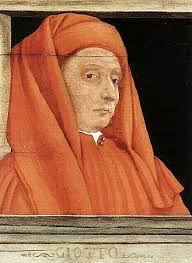
Giotto di Bondone 1266-1337


Lotta music yesterday in a beautiful private home. Our hosts are Italian speakers and supporters of the opera and the Maestro, who came in around 4.30. Immediately Gianni Schicchi the opera became more focused. Seriously, it pays to work with a native Italian speakers in an ensemble opera like this once. Especially since many of the ensembles are presto-quick. You need the dental consonants
, the  liquid vowels and the crispness of the diction. Puccini's music doesn't let you wallow in the words, but use them as intended, for expression.
Piazza Santa Croce

he Maestro also challenged me a bit with Puccini's stage directions as indicated i n the score. I see that our Gherardino will have more to do, especially at the beginning of the opera. Nico Castel suggests the boy's restlessness means he has to go to the bathroom. Fa il pipi...Maybe. The Maestro talked of a Florentine loving a bouncing ball. Whether he was kidding me-and he does have humor with an edge-a bouncing ball is not a bad idea.  He can run and bounce through the aisles. Problem is he's a cute kid and we do after all want people trained on the singers and the music,. What a balance between active stagings and respect for the music. It is possible to achieve both.  A gifted director knows how to do it. I will keep on leaning.,

Rinuccio gives us a travelogue of Florence, likening it to a tree  in flower. There are references to Giotto and the Piazza Santa Croce


I'm counting on the Maestro to keep Firenze in front of us. He is Fiorentino. Yesterday he touched briefly upon the differences in accent between a Roman and a  Florentine. A Florentine will make a lisping sound more than a Roman. Rinuccio tells us what Florence means-in beauty, trees, flowers, art, the Arno:


It's that first opening of the shutters I want you to see, from this lovely film.

And Gianni Schicchi himself reminds the Donati that nobody wants to be exiled from Florence, much less have their hand chopped off for falsifying a will:


Onward! Next rehearsal this Tuesday. Staging review for one hour followed by music rehearsal. Some of us go to visit the performance space on Wednesday. Fingers crossed.


Friday, May 31, 2013

Gianni Schicchi Diary pt. 5: Who Are These People?

I wanted to offer my ideas for back story for each of the characters. Final decisions are up to the individual artists. These are suggested. But it is important that each character, title role or one line, have a history and an idea oh why s/he is in this story.

Settings : Florence 1299
 Forzano is carefully to make the Donati family what seems to us distantly related. Zita is Buoso's cousin. .


Remember the Gibellini wrote a political faction against the Catholic church. They were routinely exiled, or worse. Rinuccio her nephew. (What does that make him to Buoso?) The rest are cousins and in laws.If Buoso had a direct line there'd be no show.

I would describe the Donati as middle class. They are literate. Buoso has money and property to leave. A mule equalled commerce and money. The mills (i mulini) were productive. And we are given to understand the 'casa di Firenze' has a roof and a floor-making it more than respectable, even enviable.

GIANNI SCHICCHI-the smartest guy in the room. Eight hundred years later he would have come straight out of Damon Runyon. He's charming, slick, smart and his only "weakness" is his daughter. What about his wife? She is mentioned neither in Dante of by Forzano. Any ideas? Gianni was born in the lower classes and is self-made. That's a problem. He no longer fits in his own class and certainly not amongst the Donati. So where does he belong and does he care?


LAURETTA-very smart. Her father's daughter. She would have been heavily guarded as a very young woman. Probably convent educated. Her love for Rinuccio is more-how to say this gently-horny than true emotional love. Knows babbino will do anything for her-that with him and probably with all men she is in control. She knows exactly how women rule men.


ZITA-matriarch. Married off young. First husband died. Married again. He died. Married a third time. He died. No children. Has built up some $$ as a three time widow but without kids enough is never enough. She is not warm fuzzy. She doesn't need Buoso's money but that's not the point.

 (Here's another way to look at Buoso's family!):


RINUCCIO Mama' s boy. We don't know who Mama is-Zita his aunt is the matriarchal figure. Was he orphaned and raised by these distant relations?  His outlook is more emotional than sexual (girls develop first). 'Fireze e come 'un albero fiorito' is a love song....to Florence, to Lauretta and to the possibilities of getting away from this crowd. Remember, he finds the will and does not hand it over easily.

GHERARDO Nice man. Henpecked but contentedly so. He has a low level job in a banking concern distantly related to the Medici. He is content with his life. He will cry after being cheated out of the Donati estate, but he will recover before anyone else.

NELLA The boss. An Italian woman of her time knows everything depends on money. You CAN buy everything. Gherardo is easy going and that's enough to make her nuts. He likes being bossed around by her so they are a devoted couple. The both dearly love Gherardino

GHERARDINO Is being schooled by the local frate when he bothers to show up. Adorable and crafty. A charmer.Completely unimpressed when his father spanks him.

SIMONE When the relatives say "Tu sei anche stato podesta a Fuccechio...You were once the mayor of Fuccechio, this is not a compliment because Fuccechio is a miserable slum outside Florence. He is the eldest chronologically but not the wisest. He's more rustic and even tho the eldest her remains physically strong. In my mind he has a wife living, ten children who survived-meaning about fifteen to twenty pregnancies-and a passel of grandchildren and they all live in the same house.

MARCO If he has so many siblings and he's here with Papa it might be that he's daddy's boy. The crown prince, to...whatever..especially without a share of the Donati estate. Let's say he's Simone's eldest child. Or the first to live to adulthood. He would be the only child who got the kind of attention parents give children today. Sons were made for procreation. Daughters to bring money into families through marriage.

LA CIESCA She's a cuddly one. She has some status as the wife of the favored son. Is she still living with her in laws and if so is she in competition with Marco's Mama? She's crazy mad in love with her husband, very unusual for the times. Do they have children? How many? Where are they?

(A married woman who is childless had no worth in medieval times. Terrible but true)

BETTO DI SIGNA The suffix di Signa means he is a property owned in Signa. He's Buoso's brother in law. How? Married to sister of is Buoso married to Betto's sister? Betto has a good business background. He is well aware of the worth of the estate, and its uses, if not sure how to acquire Buoso's money.

MAESTRO SPINELLOCCIO..literally "thorn in the eye"  As a very young doctor in Bologna he was the top dog. Ahead of his time. Handsome, successful, good with the ladies. In his mind all of this is still true, But the small healthy part of his mind realizes he's a Luddite. He is deaf, lame, and  was medically up to date in 1250. Buoso used him because Spinelloccio is cheap.

SER AMATIO  DI NICOLAO..Di Nicolao another property owner. In his day notaries were elected, meaning he has a good sense of his authority. He and Gubbio and Pinellino get weepy around "Buoso" because they are his contemporaries and know that they are likely to die next. They probably played cards together.


GIANNI SCHICCHI JUNE 15 and 16 JEWISH CENTER OF COLUMBUS presented by OPERA PROJECT COLUMBUS

Thursday, May 30, 2013

Gianni Schicchi Diary pt. 4

Aureliano Perile, tenor
I'm going to include a photo of a singer folks should know:

Puccini: Gianni Schicchi
Opera Project Columbus
 June 15 and 16
operaprojectcolumbus.com

Last night's rehearsal had more singers but no Gianni Schicchi. Puccini and Dante's Gianni had an adult daughter. My Gianni has a toddler and a cancelled baby sitter. I missed him. But we went on and did some good work.

I arrived at the church basement to find the room set with tables, tablecloths, chairs,  even a vase on each place. I had to move things around to make room and was sweating away when who should show up but the church sexton. Nice older gentleman. He wasn't too pleased with me since he had just finished setting UP these tables, etc. I don't blame him. "Big luncheon here coming up." I doubt it's during the week but okay. I promised him everything would be as he left it. And it very nearly was. I can't promise every table cloth was on daintily but I did my best. Never mind the piano is missing a caster because I stupidly moved-dragged it -myself. "And they ripped up part of the floor" said the Sexton. "Imagine!" I replied. How careless!

Then my morning was cheered by a photo my myself looking like a fat godfather, taken in rehearsal. You want to brag about weight loss? Don't wear a baggy untucked shirt on a hot night.

Well yes, but its not about me. Rehearsals are going well. One role still not cast. Another was kind enough to e mail me to say I live far way, it's  three lines and if I get to one or two rehearsals that's plenty. O-KAAAAY.
And our ten year old boy was so proud of getting his line right! He's three measures ahead but I will personally beat up anybody who gets on his case about it.

The Maestro will be at rehearsals next week .He's my friend and I love him. He's a fabulous musician. To listen to him playing with the Italian text is a joy. What if he hates the staging? Non mi frega niente. It is important that he establish the tempi he wants so the stage action is better timed.

Also I was shown a diagram of the stage with the orchestra seating re-arranged. Initially the orchestra-twenty six pieces-was to be split in half onstage. Leaving us a mall 'corridor' to use. And use it we do but we also use the house and every corner where the orchestra is not. (I'm an audience participation kind of guy)
Now we may have the orchestra all together on a slant upstage This leaves a piece of the area but it will be all ours-and we will still have the lip of the stage for our 'promenades' plus the house. This might be a good compromise.


I've been thinking about the blood and guts of performance. See the above photo of Aureliano Pertile. He wasn't born with a great voice but words, guts and musicianship made him a great artist.Verdi and Puccini do not lend themselves to a pristine performance (paging Renee Fleming) You need some blood in your singing. You need just that touch of arrogance that tells the audience THIS IS IMPORTANT AND I OWN THE STAGE. Verdi and Puccini always win, mind you-but you need to sing and act LARGE (you no longer need to BE large)

Guts. Fearlessness. Like this:


Wednesday, May 29, 2013

Gianni Schicchi Diary pt. 3

 Opera Project Columbus
Gianni Schicchi
June 15 and 16
see opera project columbus dot com 

We had a three day weekend. A surfeit of Reese's cups had me bound up and crabby, but I was rejuvenated
by the time rehearsal rolled around last night. We were at St. Marks church in the choir room, very nice with rather skimpy air conditioning. Oh, well. Beggars can't be choosers.

 I needed an emotional pick up today and speaking of Puccini:


 Moffo. What a beauty. A diva of my youth. She died in 2006 after a number of bad years career wise. When it as beautiful it was very beautiful.

 There's another opera production in business locally. That's a good thing. My old mentor Sarah Caldwell at the Opera Co.of  Boston wasn't the least bothered by neighboring college productions and a week long visit from the Met. "The more opera, the better." I agree but I haven't Sarah's gifts.


Rehearsing with many cast
Sarah Caldwell
members missing is  a challenge. Not so much for me but for the people on the stage. Remember once the show goes up I revert to my favorite position, hoping our hosts in the Jewish Center won't mind my putting my feet up.

Elvira Puccini
No notary and no Gubbio yet. Meaning it was quite tricky to stage mini processional on to the stage for Gianni/Buoso to dictate his will.  I and another fellow participated with our Pinellocchio, God bless him who comes a distance and never misses rehearsal. Still, we were crowded. I have them working in a (I hope please God) smaller space that we'll have deliberately. (You'd rather have too much booze than too little at Grampie's wake). Spinelloccio can only come late and since he's in part one only and we're working on part two.....well, I'm going to have to continue to adjust. god is good. So is zoloft..
Back to the other opera in town. Several of my key people are involved. What can I do? I'm the last one who would tell them to give up a paying gig.

Our baritone sings well and has the rare gift of singing with enough joy to enchant any audience. Many of the other singers are well prepared and fun. Some need work. I've been asked to save time in staging rehearsals for some  music touch ups. Withal, we've staged the whole thing, now its fine tuning, a few changes and eventually complete runs. Since there's so much physical action I need the singers to develop  muscle memory so their singing is not affected. I have asked for a brief meeting in the venue with as many as can attend.Even if a few show up, if they see the actual space it may offer better perspective.

Puccini by Mary-Jane Philips Matz
And how many directors do YOU know who send out a prop list for spoons, forks, dishes, a night cap and long johns? Take THAT Franco Zeffirelli!

I've been re- reading Mary Jane Philips- Matz's biography of Puccini. Her Verdi bio is the book of choice. No one in recent times has better documented this great composer. Puccini is a more friendly read and less scholarly. Matz makes good use of several very elderly people she met years ago who knew the composer. I wanted to interview her and mailed and e mailed and called and a week later read her obituary in the New York Times. She was pushing ninety. No one who loves Verdi or Puccini should miss her books. 

Puccini loved fast cars, women and hunting. He was quite the ladies man. His first serious girlfriend was the wife of another man. She and Puccini had a child together-scandalo!-and composer rued the day he took up with Elvira. Batshit crazy the lady was.

Hmmm. Maybe I can turn Ciesca or Nella into Elvira Gemignani Puccini. Scary!

Tuesday, May 28, 2013

Will Schwalbe and The End of Your Life Book Club


Wanna fall in love? You will, if you read Will Schwalbe's memoir of his mother's final years as she battled cancer. The End of Your Life Book Club is by no means a depressing book. It's not even sad, and I expect that's because Mrs. Mary Ann Schwalbe would not have it so.

Mary Ann Schwalbe
I get a lot of books every week, many of them memoirs and to not a few I sigh, "Who cares?" I cared about this one. It's one of the most life affirming books I've read in quite a while. It's about an adult son finding one more way to bond with his mother. Through books. And its about a remarkable lady who I am sure is in heaven re-arranging the clouds and helping others as I write and you read.

Will Schwalbe is one of three children of Douglas and Mary Ann Schwalbe. Mrs. Shwalbe had been an educator, administrator and in her later years a relentless advocate for refugees. If you've ever crowed about working through a headache, get over yourself. Mrs. Schwalbe worked through chemo building roads, schools and libraries in Afghanistan.
Will Schwalbe
Cambridge, Harvard to New York's Upper East Side. Enough to make my two toilet Irish heart groan. But I shut up and read and yup, I fell in love. Mrs.

Here's a conversation I had the other day with Will Schwalbe. He's riding a very successful book AND a terrific website dedicated to recipes and cooking, cookstr dot com. Will feeds your tummy. His mom will feed your soul.

CP: You've written  a book about your mother's final years, but you have not written a sad book, a depressing book, at all

WS: Thank you. I wanted it to be joyful.

CP: Tell us you about your mother. This was a very unique and busy lady

WS: She was. When I was growing up Mom was director of admissions at Radcliffe and Harvard, then she and my father moved back to New York City and she became an educator, then a college counselor, and head of a girls school. Then in her fifties she discovered the cause of refugees. She became the founding director of the first organization in the world devoted to specifically the cause of women and children  refugees. . She spent the next two decades traveling all over the world working on behalf of refugee women and children.

CP: When she was doing that you and your siblings were grown, is that right?
WS: That's right. We were all out of the house

CP: Do you think that's what empowered her to go in that direction, that the kids were gone?

WS: I think that was a big help. She was really galvanized by them, and if she had been exposed to refugees  as she almost accidentally was, in her fifties, she might have done something. But as far as taking on a position like that and really traveling all over the world , I think she would have waited.

CP: You and your mother connected over books. But ti strikes me you and she were never not connected

WS: We were very close. We did live for many years in different cities. We had the same kind of contact many adult children have with their parents, a phone call every couple of weeks. That said, we were always close. One of the things I really wanted to try to do with this book was to write a book that would resonate  with people who do happen to be close to their parents.  A lot of people have sadly had difficult and troubled relationships with their parents.  The memoir shelves are filled with those. But a lot of people were lucky enough to have wonderful relationships with their parents and to some degree I wanted to create A book for those people, too.

CP:  When your mother was diagnosed with pancreatic cancer, it struck me that she just have been...annoyed...like "I don't have time for this!"

WS:: (laughing) I wish I had used that because that's exactly it...It was the full range human emotions, from anger, sadness, despair and  hope.  But there was a big dose of annoyance there, too. She didn't have time for it. She had too much to do.

CP: How long after your mother's diagnosis did you two decide to have your own book club?

WS: She was diagnosed in October, and it was really the very first time I went to chemo with her in November  we started talking intensively about books..  It was at that time I joked that if we kept  "meeting like this" and talking about books it was like having a book club.

Mom's initial reaction was to say Oh, don't be silly . sweetie, we couldn't possible have a book club.
Date cupcakes form Will's web site: cookstr.com
I said why not and she said, Because there's no food!
She felt book clubs must have food!

CP:: Or at least booze!

WS: At least booze, exactly. I really should have had a flask in the chemo suite.

It began as a light hearted thing and it was only after time that we realized we really had a in a way created this two person book club.  We began to be more thoughtful about our conversations and the kind of books we read..


CP:: And you didn't necessarily agree on every book...

WS:: We really didn't. We had very different things we loved in books. I love books that are maximalist, like Dickens. Filled with characters and details and plots and everything that happens in the beginning comes back in the end.

My mother really loved sparer, more lyrical books, where the emphasis was more on prose than character.
A book like Marilyn Robinson's Gilead which was perhaps my mother's favorite  contemporary book. Mine was more like Rohinon Mistry's A Fine Balance.

CP: Did your relationship with your mother change as you pursued this book club, alongside her impending death?

WS: It deepened. It didn't change in its fundamentals. I got to see more of her. I knew my mother had a wonderful sense of humor, and I got to see more of it. I knew my mother was a brave person but I got to learn more about her bravery. I knew she was compassionate, and I got to see her theories of compassion and learn her rules for herself. It was getting to know someone better and I guess you could think meeting a slightly different person, too.

CP: What about your siblings?

WS: My brother lives outside of New York. My sister was offered a fantastic job in Switzerland, and after a lot of discussion she took the job but came back frequently to spend time with Mom.

CP: Did your siblings have bonds of their own with their mother. you had the book club, did they have something else with her, by themselves?

WS: My siblings are also voracious readers. I'd say the biggest difference is that both of my siblings have children. Had you asked my mother her greatest accomplishment and pleasure in life, she would have aid without hesitating, being a grandmother. I think that in some degree when my sister and brother were around my mom really wanted to talk about the grandchildren. When I was around her she also really wanted to talk about the grandchildren , but after I had exhausted the updates on my niece and nephews we would move on to books.


CP: You forged something special to you and mother. Just for the two of you. That's the heart of your book as I understand it.

WS: I was very careful to say in the start of the book that my brother and sister had equally deep and important conversations with my mother, but I really felt their stories were their stories to tell, not mine. I think a lot parents that I know have different relationships with each child that is unique to that child. '

CP: The most moving part of the book for me is when , not long before her death, your mother was honored at a dinner in New York. It was very effortful for her to attend , but you said that this woman with years of accomplishments in her life was taken aback by all the accolades

WS: It was very important to my mother in her refugee work that she always  push the refugee voices front and center. If ever there was an occasion to speak on behalf of the organization, Mom wanted it to be refugees. As an educator it was about children not about her . Yes, she was a woman of great accomplishment but she had always been a little bit in the wings, pushing other people out to the stage. She was very moved to be acknowledged in that way before she died.

CP: How was your father through all of this and how is he now?

WS:  One of the amazing things books did for mm and me was it gave us a way to talk about really difficult things. The subject of how my dad was going to fare after Mom's death was one of those things. We were reading a book called Crossing to Safety by Wallace Stegner. Really one of the great books I've ever read.

The book had a character that is dying of cancer. I was able to say to my mother, Do you think that character's husband is going to be OK after she dies. And my mother was able to say Yes, he will be very sad, but he will be OK. And that's as close as my mother and I ever got to talking about how my father would do, and in fact that was exactly right. That's just what happened.

He's very proud of the book. He's very supportive of the book, He always knows where I am and who I'm talking to , but he doesn't want to talk about the content of the book. He basically says to people, That's my son's book.  


CP: Finally, is there one book you and your mother did not get to read together that's a regret?

WS: That's such a good question. I would say that as much as we talked about poetry, and we read poets like Mary Oliver , I wish we'd read more poetry together. I wish we had been able to talk about some of the poets she was re- reading . She spent a lot of time re- reading Robert Lowell. I didn't get to talk talk to her about Robert Lowell, and I really regret that.
 
CP: She probably knew Robert Lowell

WS:: She probably did...that whole circle Robert Lowell, Elizabeth Bishop. She spent a lot of time re reading the poets she had read in her younger years in Cambridge, Massachusetts. I knew she was doing it and I wish I had talked to her about that.

CP: The only regret I have in your book is that I never met your mother. I think everyone who reads this book will feel the same way. This is a lady you would have loved ot have had in your life . Thank you.


Friday, May 24, 2013

Gianni Schicchi Diary pt. 2a Giuseppe de Luca

Giacomo Puccini (1856-1924)
You can go to all the language labs you want, take all the classes there are, spend your money, but if you're a singer wanting to learn beautiful Italian, go to the library and get recordings of Italian singers. Nothing is more beautiful than listening to Pavarotti sing Donizetti and Verdi. Tebaldi in anything. The great baritones Tito Gobbi and Ettore Bastianini.Bass Cesare Siepi.  Renata Scotto in Lucia or Traviata. Scotto was the diva of my operatic youth. You couldn't avoid her, and her voice was long shot. And yes, they'd flock to her today. Just a few lines of Mi chiamano Mimi were riveting.

Why do I harp on this? I don't like young singers being bilked for money. I've never been sold on the
Giuseppe de Luca
college/grad school route. Better to get a marketable degree and study voice, languages and theory on the side. Then try for the competitions and young artist's programs. If after several years nothing happens, start your own preforming organizations, conduct a choir for underprivileged kids and go make yourself a life in music. Tend bar or do IT during the day. No disgrace in any of these. The goal is to have a life in music and share that life with others.

Wow. Focus Christopher.

Giuseppe de Luca. He was the first Gianni Schicchi. You can lean so much about words and legato from him.


Giuseppe de Luca (1876-1940) sang well into his seventies. He came to the States in 1915 and three years later was the first Gianni Schicchi. He had created Sharpless in Madama Butterfly in 1907 and Michonnet in Adriana Lecouvreur in 1901, the latter with Caruso who he frequently partnered.

I'm not surprised to read raves about his singing in 1918, 1930, etc.
But in 1940 he made a comeback at the age of sixty-four.
He sang Germont in La traviata.

Giuseppe de Luca, the veteran baritone...stepped from the wings in the second act. It is not surprising that on receiving the thunderous tribute from the audience, it was hard for Mr. de Luca to control his features or summon the breath to sing. ...When he did open his mouth the first five notes made the pulses beat because of the art and the beauty of the song...The quality of the legato, the perfection of the style, the sentiment which ennobled the melodic phrase, struck the whole audience...

       Olin Downes, New York Times February 8 1940

(They really had critics then,didn't they? Olin Downes was no pushover)
             
de Luca sang Schicchi twenty -six times from the premiere in 1918 through 1934.  De Luca returned to Italy the following year and came back to New York in 1940. (I'm surprised Mussolini allowed him to leave)
Geraldine Farrar as Suor Angelica...unimpressed
By the way, Il tabarro disappeared after 1920 until 1946. Suor Angelica did not impress soprano Geraldine Farrar, who created the role. She and Caruso were the Met's biggest box office attraction. After she retired in 1922, Suor Angelica disappeared until Renata Scotto sang it in 1975.