Showing posts with label Verdi. Show all posts

Saturday, October 11, 2014

Salve o Macbetto!

Verdi: Macbeth Live in hD from the Metropolitan Opera, conducted by Fabio Luisi. With Zelko Lucic, Anna Netrebko, Joseph Calleja, Rene Pape.... Seen at Lenox AMC Columbus, October 11 2014

WOW!

Today for the first time in years I missed my old life in New York. I romanticize those times, but a lot of it was fun, important and the memories irreplaceable.  My new York was still affordable to students. My New York is long gone. My old haunts, Tower Records among them, the  New York City Opera, Hot Woks Chinese, all long gone. Studio apartments rent for $5,000 a month if you can find them. They are not nice apartments. The working class and the creative class seem unwelcome. It's the very very rich and the very very poor.

I'm just home from seeing Verdi's Macbeth, as presented by the Met this afternoon. I wasn't there in person. I saw it on the big screen, live in HD.  It's a murky production, not much to look at, very dark and unimaginatively staged.

What the afternoon did have is what I remembered from the 1980s: buzz, excitement, blood, frisson. It was important, dramatic music theater and it was all about great voices. Anna Netrebko assigned her sex kitten  with a whip persona to a shattering and  glamorous Lady Macbeth. She sang the fearsome role....with no fear. She had guts and beauty and you could tell from Columbus Ohio that her energy burned through the Met. The  vanilla-ization of opera was no here to be seen today. The baritone Lucic is not much of an actor but oh my he sang. It 's a woody baritone voice, not intrinsically beautiful. But he sang the music beautifully, and like La Anna he sang with guts. Rene Pape, what splendid glamor casting for Banquo. There's a beautiful voice. Likewise Joesph Calleja -he brought line and class to a fine "Ah la paterna mano".

Noah Baetge! Remember that name. He's a big boy who sang Malcolm and will soon graduate to the big boy parts.

HD closeups of the Met chorus show that no one cheats at he acting and involvement, not for one moment. And the Met chorus sounded what like hat they are....the best in the world. Likewise of course the peerless orchestra. Fabio Luisi knows his Verdi ad knows that this is one of the most theatrical of composers. The music making was rich and detailed and flew by.

Why do I rave on so? Again, the buzz was back.  Opera became an Event once more. It wasn't pretty and it wasn't adorable and no one was skinny and it was ferocious and fantastic. The audience was stamping and roaring and screaming. That used to happen all the time in my day, when Sutherland, Price, Pavarotti,  Milnes, Domingo, Siepi were regulars. I was wondering what shows these days I would wait in line for. Well, this Macbeth for beginners.

Am I right? Did the guts come back today? I became very nostalgic for my days in New York (1978-1991)...Yeah it was the grad student cliche. Selling records at Barnes and Noble to keep me in ramen noodles, ketchup, three dollar bottles of wine and standing room tickets ($2).  In those pre-9/11 days you could sneak in sandwiches and beer and we'd picnic on the floor at intermissions. I know most of the ushers from my Opera Quiz days. They left us alone. After the show we'd all repair in the late evening to Tower to look at records (RECORDS) and arrogantly and joyfully rip to shreds what had been a splendid evening. Then you'd pair off if you were lucky or go home for another day if you weren't,

My life today is rich, full, exciting and filled with responsibility for which I am prepared. But it is good to remember an earlier time and to realize that those days gone by are creeping back.

Tuesday, December 31, 2013

One Verdi Opera per Day: At Last, Falstaff

Tito Gobbi
Today marks the final day of Verdi's bicentennial year. I've made it a point to listen to every one of his operas, minus some of the revisions, in sequence. I came across some unexpected new hits, including Alzira which the composer himself disowned. It was great becoming acquainted with Il corsaro and I masnadieri. Less so with Un giorno di regno.

There are a handful of operas considered to be miracles. I'm not sure how subjective my list is: Il ritorno d'Ulisse in patria; Cosi fan tutte; Norma; Aida; Tristan und Isolde; Otello...to these I would add Giuseppe Verdi's final opera, Falstaff 

http://www.youtube.com/watch?v=7lOSvvsXTus

Verdi's fat knight out of Shakespeare has been much in the news lately. The Metropolitan's new production is a huge hit. The action has been moved from Elizabethan Windsor to Elizabethan II Windsor, circa 1955.I thought everything worked. The costumes, big bellies and big hair, the dirty underwear, what was not to love? Ambrogio Maesteri owns this role. You know why? Language.

Falstaff is about language. Not just for its Shakespearean roots but but for Arrigo Boito's masterful
Boito and Verdi
adaptation and translation. Mrs. Quickly sprouts "Povera donna!"  a dozen times and its never boring. Falstaff makes love to himself, to youth and to the audience as remembers his days in service to the Duke of Norfolk, when he was sottile, sottile, sottile (skinny skinny skinny)

http://www.youtube.com/watch?v=ukS7qDd4pDA
Ambrogio Maesteri

Falstaff's word setting is conversational. You needn't know Italian well to listen to this opera as one would watch a masterful TV sitcom. I Love Lucy and Vitametavegimin comes to mind. Or Carol Burnett as Scarlet O'Hara. The ensembles often sound bus, because the characters are, plotting against one another-wives v. husbands. The forward momentum, often the joy of the music makes Falstaff a "fast opera", over before you know it and you want to hear it again. Now.

Verdi knew what he was doing, saying goodbye with a comedy. Falstaff himself is US. We are all foolish, silly and stupid. We all deserve both comeuppance and forgiveness. Other people need to laugh and need to forgive. My favorite parts of this score are the juxtapositions of the raucous with the sublime

http://www.youtube.com/watch?v=YTUZ1REr0yY

The great final fugue borrows lines form a different Shakespeare play. Tutto nel mondo e burla: The whole world is crazy. This is the farewell of Verdi and his gift to the audience. W know the composer was a taciturn and rather unpleasant man. Sad to think he was suppressing such sentiments, such music for eighty years. But the last six minutes give us a g'bye with happiness and no bitterness. VIVA VERDI.

http://www.youtube.com/watch?v=LvFyDeOwMtY


Tuesday, October 22, 2013

One Verdi Opera per Day: Otello

OTELLO    
Arrigo Boito after Shakespeare  January 5, 1887  La Scala, Milan


Mario del Monaco, Renata Tebaldi, Leonard Warren, Martha Lipton, Paul Franke, Luben Vichey, James McCracken (Roderigo) Fritz Steidry conducts  Metropolitan Opera broadcast  March 12, 1955

This gets harder. It wasn't too difficult to offer impressions of the early Verdi operas. I liked Aroldo and Alzira , didn't care much for Giovanna d'Arco. But when you get into Aida=Don Carlo it gets harder to know what to say. Otello is harder still. I love this opera. I'm thrilled by it. But I seldom listen to it. So real does the tragedy become for me that I can't bear knowing what's to come, even from act I. Still, what tenor has a greater entrance than Otello's 'Esultate!'.  What baritone has a more sinister monologue that Iago's Credo.


And what soprano has the exquisite Salce and Ave Maria for Desdemona.


I avoid listening to Otello partly for what I've already stated, and partly because I fear the miracle of it won't hit me. I listened again today. I got hit.

Look at the devices used to relive tension. The Fuoco di gioia! chorus in Act I. The magnificent offstage serenade of Desdemona in Act II. Then in Act III, after Desdemona is insulted by her husband ('vil cortigiana!) Iago seduces Cassio-I intend that word, seduce-first with bel canto:Vieni...l'aura e deserto...and then piu rapido.


The final act orchestration always sound spare. Not just eerie, but haunted. Otello's suicide till keeps wit hit a degree of dignity-he remains a heroic figure, an important person, even after falling prey to Iago and murdering his wife. Verdi forbids us to regard Otello as stupid. Which is easy to do!


Tuesday, October 08, 2013

One Verdi Opera a Day: AIDA


 Aida  Antonio Ghislanzoni  Auguste Mariette, Bey  Cairo  1873

Leontyne Price, Rita Gorr, Carlo Bergonzi, Mario Sereni, Cesare Siepi. Georg Solti conducts. Metropolitan Opera broadcast, December 7, 1963

One British critic wrote, "Aida brings out the epicurean." Spare me. Here's a four act opera set in the Egypt of the Pharaohs. Dark body paint, walk-like-an-Egyptian,  all singing away in Italian. Are you dying
laughing? No one ever was. Aida has not one spare note of music.
Aida was my first. Do you remember yours. It wasn't the initial "sigh of the violins" that got me, but the low strings introducing the second theme in the prelude.

http://www.youtube.com/watch?v=iUMaMmmc6bU

Aida introduced me to great voices and to drama. With no sense of the plot and no Italian , anyone can feel something else is about to happen. Something dangerous. There's a lot of  urgency of this music. Even at its most seductive and romantic, there is always the sense that something is about to happen


Verdi gives us splendor unparalleled in opera, and a sad, gorgeous death scene, all in the same score.


and there's no topping Verdi's triumphal scene. The composer doesn't give even try. Verdi gives us a finale of deep quiet and beauty:


I remember in particular  two productions of Aida. One in 1980. The Opera Company of Boston. Sarah Caldwell staged and conducted the work for Shirley Verrett. Verrett was going through her "I'm a soprano" phase, with hits and misses. Her Aida was a hit. At least as I heard it. She was regal, she was tragic and her
voice soared to touch heaven. James McCracken was Radames, a big burly man with a weird , opaque sounding voice. But power he had and beauty, too. Elizabeth Connell, Amneris and David Arnold, Amonasro. Ramfis was Ferruccio Furlanetto in his American debut. Sarah got lost in the prelude during the first performance. It was one of those start again moments only she was damned if she was going to start over. The assistant conductor was standing in front of me hissing "Jesus!" "shit!" and worse. Sarah was nonplussed.


Leontyne Price made her farewell to opera as Aida, a part she owned. It was January 5, 1985.McCracken was Radames. Some of us wanted to go back and see him but he told us, "Hell,  they'll barely let ME backstage." Miss Price's farewell was an electrical event. The lady had been dealing with a hoarse and froggy lower register for a few seasons. but on this night, all was well. Her voice was filled with splendor and light and passion and she was Leontyne Price and I was there, in standing room:


Aida, the opera of humanity. Viva Verdi!

Friday, September 13, 2013

One Verdi Opera a Day: Aroldo, Un ballo in maschera, La forza del Destino

Verdi looking Russian
Continuing with my listening to one Verdi opera a day, in chronological order, in honor of the composer's bi
Caruso in Un ballo inmaschera
centennial

Aroldo Frncesco Maria Piave  1857  Rimini

Montserrat Caballe, Gianfranco Cecchele, Juan Pons, Vincenzo LaScola, Luis Lehbrez; Opera Orchestra of New York/Eve Queler


Verdi was disgusted with the Franco-Austrian censors and disappointed that some of the public disapproved of Stiffelio. A Protestant pastor and a German no less! The music was too good to waste, thus Aroldo. Aroldo moves the action to medieval England and Scotland-medieval British more tolerated than 19th century German protestants?-The music is not the same, the plot is very similar. If you know and like Stiffelio, Aroldo is well worth a spin. I've never heard Aroldo performed live. The above cited recording is great, but cut. Seek out Fabio Luisi's more recent recording on Philips.


Un ballo in maschera  Antonio Somma 1859 Rome

Maria Callas, Giuseppe DiStefano, Tito Gobbi, Eugenia Ratti, Fedora Barbieri. La Scala/Antonino Votto 

First of all, where are you? Late 18th century Sweden or Colonial Boston (God bless us and spare us). The assassination of King Gustav III of Sweden at a Masked Ball is the basis for this opera. So far, we've met a lot of great Verdi women: Elena/Helene, Giselda, Abigaille, Lady Macbeth, with a lot more to come. Ballo for me is the tenor's opera. Go ahead, laugh. Gustavo is written to well display a strong lyric tenor voice. I always loved Pavarotti in this opera.


 And this sparkling bit for Oscar is effective against the dark plotting of Renato and the assassini


La forza del destino  Francesco Maria Piave  1862 St. Petersburg

Renata Tebaldi, Mario delMonaco, Ettore Bastianini, Cesare Siepi,

Imperial Theater, St. Petersburg
Oh, the singers ho used to perform this opera and oh, the paucity of them today! I hadn't listened carefully to Forza in a long time. It's sprawling, yes and there are a fee moments of crowd painting you could miss-but the tenor/baritone duets!


Leonora's three arias-the scene with Guardiano, and the final trio! If you listen to this closely it will stay with
you for days. I'm not familiar with the score as given at the premiere, only the changed version now performed. This is a heavyweight big/boy big girl opera. Thrilling.


Thursday, August 29, 2013

One Verdi Opera a Day: La traviata, I vespri Siciliani, Simon Boccanegra

Renata Scotto as Elena in I Vespri Siciliani


I'm continuing to listen to one Verdi opera a day, not on consecutive days but in
order, in partial celebration of the Verdi Bicentennial. I'm also making use of Mary Jane Philips Matz's magisterial biography of the composer, along with books by Julian Budden and Francis Toye. Mostly I'm just listening for my own enjoyment, as I hope my comments reflect


Maria Callas in La Traviata
La traviata   Francesco Maria Piave, based on Dumas fils "La dame aux camellias"  Venice 1853
Inspired by the courtesan Marie DuPlessis (1824-1847)

Maria Callas, Giuseppe DiStefano, Ettore Bastianini/Carlo Maria Giulini La Scala 1955

 
La traviata is an easy opera to take for granted. The story had notoriety before Verdi/Piave got to it, mostly via Sarah Bernhardt and Eleanora Duse. What begins in a brittle and cynical manner becomes an exercise in sincerity that dares you to mock. Violetta may be to sopranos as Hamlet is to actors. Again, Verdi is a great tune smith


We go from hedonism to pathos to deeply moving drama


The role of Alfredo is misleading. He has less to do emotionally in the opera. The heart of the piece is the Violetta-Germont scene in Act II. But Alfredo is no easy sing. He's worth doing for the Act III scene at Flora's if for nothing else


 Don't miss the new biography of Marie DuPlessis, whose life inspired Dumas fils and Verdi 

The Girl Who Loved Camellias by Julie Kavanaugh


Les vepres Siciliennes   Eugene Scribe/Charles Duveyrier  Paris 1855

Alexandrina Pendatchanska, Gregory Kunde, Dario Solari, Orlin Anastassov/Gianluigi Gelmetti Naples 2011

I vespri Siciliani  Ettore Ciami  Perugia 1855

Renata Scotto, Placido Domingo, Sherrill Milnes, Paul Plishka/James Levine
Metropolitan Opera November 4, 1974

 
These are two different operas with the same music and plot. Verdi wrote a French opera, to a French text for the Paris Opera.

In Verdi's day opera was sung in the language of the audience, thus necessitating an Italian translation, which
Salle Le Pelletier, Paris c. 1850
the composer hated.  Most of know I vespri Siciliani better than Les vepres Sicilienne. I don't know the French text very well. Even so I can tell the words fit the music perfectly. The French language gives this opera dignity the Italian lacks, the latter becoming more of a pot boiler. I would love to see a staged French language production of Verdi's original. I imagine Vepres/Vespri is a bitch to cast. The duets for Henri/Montfort and Henri/Helene are highlights for me. But my favorite moment in this opera is at the very beginning. The Duchess Helene demands her fellow Sicilians rise up against the French: Some of what I mean is at 4:00. But this is a wonderful clip surrounding the Verpres production from Naples cited above


Verdi knew that the Italian Vespri would run afoul of the censors. The Italian libretto was refashioned and called Giovanna di Guzman.  Whatever.
 
For I vespri Siciliani, here's a recent production from Verdi's own Parma:


 BTW: Verdi was also working on the French edition of Il trovatore--Le trouvere


Tito Gobbi as Simon Boccanegra

Simon Boccanegra   Francesco Maria Piave   Venice 1857  Music revised with new text by Arrigo Boito Milan 1881

 Tito Gobbi, Giorgio Tozzi, Leyla Gencer, Giuseppe Zampieri, Rolando PaneraiGianandrea Gavazzeni  Vienna Opera Orch and Chorus at the Salzburg Festival August 9, 1961

Sometimes I think this opera gets lost between Traviata and the impending, Ballo, Forza and Don Carlo. I've never paid it enough attention. The tenor and soprano take a back seat to the baritone and bass. Well, I'm here to tell ya, this is one powerful opera. If you don't know, invest 2 hours in a listen. Verdi's music captures both the image of the sea and the grandeur of the Venice of the Doges. There are moments of great intimacy, notably the soft 'Figlia' sung by SB after meeting his adult daughter. The Council Chamber Scene, added in 1881 (I don't know the 1857 version, as far as I know it is rarely performed) I've seen Simon Boccanegra and it plays like the grand opera it is. The last thirty seconds are especially thrilling. Boccanegra dies of poison. The crowd outside is calling for him. Fiesco says Greet Gabriele Adorno, your new Doge. No! Boccanegra! He is dead. Pray for his immortal soul". "


Verdi was apparently discouraged and annoyed with thew opera's failure in 1857. He had written it off until Boito convinced  the composer to accept the revisions, giving us the opera as performed today. Don't miss Simon Boccanegra


Monday, August 19, 2013

One Verdi Opera a day: Stiffelio, Rigoletto, Il trovatore

Now it gets intense. The challenge is to say something new about Rigoletto and Trovatore. The hits just keep on coming.

But  Stiffelio is not well known. There's a story to be told:
 
If you write an opera called Stiffelio,  you'd better be sure it's a good opera.
Giuseppe Verdi wrote a three act tragedy based on the play Stiffelius back in 1850. The story is  the tale of a Protestant pastor who forgives his wife her adultery. There is a very effective closing scene, as Stiffelio preaches the gospel of the woman taken in adultery and proclaims that Christ pardoned her. "Perdonate! Perdonate!" he cries as his wife makes her way toward him down the church aisle.  Handled right,  this is a simple and moving scene.


 Stiffelio has been called Verdi's forgotten opera. Until very recently it was  never performed. The 1850 premiere was ruined by the Austrian censors active in Trieste. They demanded so many changes (a minister with a cheating wife, indeed!) that Verdi lost interest and moved on.


Verdi's estate at Sant'Agata, near Milan

I'm here to tell you however, that Stiffelio is not forgotten,  silly title and all. This writer sang in the chorus of the American staged premiere. Sarah Caldwell directed and conducted Stiffelio with her Opera Co. of Boston in 1976. Sarah was one of those people who could make a cheese souffle out of peanut butter, graham crackers and a turnip. She never paid the bills. Her theater was a movie house in a bad part of Boston. Porno on Tuesday, Opera on Wednesday. The dress rooms were the stinking back alley. Never mind.

Such was Sarah's creativity that she attracted big name singers. Stiffelio was to star the Canadian tenor Jon Vickers. He was still at the height of his powers in 1976. Soprano Anna Moffo would sing Lina. In 1976 she remained the most beautiful and glamorous figure in opera. She had lost her voice at least five years earlier, due to over work and poor training. Stiffelio was meant to be her big comeback.

Jon Vickers never came to Boston. He sent word from his estate in the Bahamas that having studied the score he was convinced the part was too difficult.  No Vickers, no opera. NOBODY sang this opera in 1976. Moffo arrived and everybody else began  to rehearse without the title character. She was on every talk show and this production had enormous pre-publicity.


Long story short. Glamorous and diva like in public, Anna Moffo was warm and kind and professional in rehearsal. It was clear to all of us she was still in vocal difficulty. Remember there was no leading man. Eventually, Sarah forced the role on a young tenor and he valiantly went on. He did himself nor the audience any favors, poor guy. Miss Moffo sang one performance. Her voice quit completely mid way of performance 2. A chorister sang from the wings. Moffo went home to Fifth Avenue and RCA, and Stiffelio limped on the understudies.

With all of that, it was clear this was a wonderful opera. It's hard to cast. Still unfamiliar, it demands accomplished singers-and they are expensive and you can't bounce their cheeks as Sarah did to the rest of us. Nevertheless it was a good-looking, well costumed production. The media who came for Moffo stayed for Verdi. Bad luck with casting also plagued Verdi himself but in 1976 it was okay for a pastor to have  cheating wife onstage.

The Opera Co. of Boston closed its doors in 1991. Stiffelio arrived at the Metropolitan in 1993. I remember being annoyed that all the press coverage ignored the 1976 Boston production. Phooey. We got there first.


Rigoletto  Venice 1851
Francesco Maria Piave, after Hugo's Le roi s'amuse

Tito Gobbi, Maria Callas, Giuseppe Di Stefano. La Scala/Tullio Serafin
 
The censorship that crippled the inital run of Stiffelio wreaked havoc with Rigoletto. Victor Hugo was anathema to conservatives. Regicide on stage? Impossible. If the King (Duke of Mantua) has to live he'd better have terrific tunes:


Rigoletto endears itself to the public for the tenor's tunes. The scenes with Gilda and her father are gorgeous and heartbreaking. And the jester himself is a glorious acting role. And what a sing!


Verdi knew what he had. He didn't let a note of this score out of his sight until after the first perforamnce. He eknew every organ grinder in Venice would take up thersr melodies. Where ios there such a balance of tunes and true drama. The beautiful father-daughter dynamic is simple. That it is memorable here is due to Verdi's passion.


Il trovatore Rome 1853 

Salvatore Cammarano and Leone Emmanuelle Bardare after El Trobabor by Guiterrez

Jussi Bjorling, Zinka Milanov, Fedora Barbieri, Leonard Warren/Renato Cellini


 Get in there and fight! Get in there and sing! The Marx brothers made fun of Il trovatore and do many others. It is a stand up and sing (or get in there and fight) opera. You need superlative voices. If the singers aren't well matched the balance can annihilate those lest....sonorous. In Trovatore,  the forward momentum Verdi first demonstrated in Nabucco is perfected. This is a swift moving show. One of the gems for me is the offstage nun's chorus in Act 2 sc. 2. The set up toward the battle between Manrico and di Luna and Leonora's rescue ("Donna, mi segui!") is thrilling.
Azucena becomes the pivotal character. A woman who murdered a child and becomes a craezd, pathetic figure has the most dramatic music.


The monks chanting the Miserere, Manrico sings from his prison and Leonora, hearing all this...di te scordarmi!


Monday, August 12, 2013

One Verdi Opera a Day: Il corsaro, La battaglia di Legnano, Luisa Miller

There is nothing at all boring about this essay of the Verdi operas. I am listening to one, complete, no interruptions each day. Herewith just a few gut reaction comments. so far, I Lombardi, I due Foscari and Alzira have been exciting surprises. Giovanna d'Arco and Un giorno di regno not so much.


Giuseppina Strepponi, Verdi's wife after 1859
Il corsaro    libretto Francesco Maria Piave after Lord Byron     Trieste  1848

Carlo Bergonzi, Darah Reese/David LAwton Stony Brook NY 1981

Is this the second least known Verdi opera after Alzira? I liked Alzira. I like Il corsaro, too. It's another Il corsaro. It's an opera worth doing if you have a strong tenor.
Lord Byron hyper romantic impossible situation with a Pasha, two women, a harem and a tenor pirate. This is the tenor's opera, though each soprano has a fine aria. The finale is quite beautiful, as Medora dies after poisoning herself. The love music isn't memorable. Verdi was still in his noisy more-is-better period-But there's lots of stirring music. Forget the story. Michael Fabiano would be great in


La battaglia di Legnano   libretto Salvatore Cammarano after Joseph Mery   Rome 1849

Jose Carerras, Katia Riciarelli, Matteo Manuguerra/Lamberto Gardelli


Verdi had been chided for no longer turning out his patriotic operas. Perhaps La battaglia was his response. The political struggles here are clothed in the occupation of Milan by a German emperor. Verdi achievers a synthesis here of political rabble rousing and heart. This is a terrific opera, worthy of revival. The finale, with the death of Arrigo on the steps of the Milan cathedral, is a melodramatic treat. I'd like to see this done on stage-Michael Fabiano, Angela Meade, Rene Pape, --and for the big Verdi baritone Rolando---??? well, only Delavan comes to immediate mind.


Luisa Miller  libretto Salvatore Cammarano after Schiller's Kabale und Liebe   Naples 1849

Montserrat Caballe, Luciano Pavarotti, Piero Cappuccilli/Gianandrea Gavazzeni La Scala 1976


It was Anna Moffo's photo on the cover of her recording of Luisa that got me to listen to this opera forty years ago. I've always enjoyed it. We get the first deeply moving father-daughter scenes, especially in Luisa's last act. The tenor had a great extended scene. If the situations are not quite believable well, that's opera folks. Two good bass roles, with Count Walther given some lovely music in Act I. Likewise the Act I finale on paper has a keystone cops quality saved by dramatic music. This is an opera for a Trovatore like cast of soprano, tenor and baritone. If Verdi were alive today he'd cast Zajik or Blythe as Frederica.


Friday, August 02, 2013

One Verdi Opera a Day: Macbeth, I Masnadieri, Jerusalem

Verdi circa 1848
Jenny Lind


I'm listening to one Verdi opera a day in honor of his bicentennial.
My comments are just a bit of 'gut reaction'
This continues to be a wonderful journey!
Listening to and reading about these works beats any vitamins for me, although chocolate could run anything a close race.

Macbeth  1847 Florence   revised 1865 Paris
Francesco Maria Piave

Peter Glossop, Rita Hunter, Joh Tomlinson, Kenneth Collins/John Matheson BBC Broadcast   1847 version

Piero Cappucilli, Shirley Verrett, Nicolai Ghiaurov, Franco Tagliavini/Claudio Abbado  La Scala 1976      1865 version


"He is the poet I revere above all others" wrote Verdi about Shakespeare. The composer knew the plays inMacbeth needs a formidable conductor, who is not tempted to play the witches for comedy. I'm riveted  by the Act 1 duet, 'Fatal mia donna!' and by the Brindisi in Act II...the entire scene with the vision of Banquo's Ghost. Once past Act 1, Macbeth 's grows in power. The third act vision scene and duet for the Macbeths, and the sleepwalking scene are first class Verdi.
translations, first made available in 1838.


Emmanuele Muzio
I masnadieri  1848  London
Andrea Maffei

Carlo Bergonzi, Montserrat Caballe, Piero Cappucilli, Ruggero Raimondi/Lambero Gardelli


Based on Schiller's Die Rauber , written for London and soprano Jenny Lind. Ernani.  No problem with that certainly, but we are absent any convincing love music. My least favorite Verdi thus far. But I'd rather sit through my least favorite Verdi than the best of many another composer.
Her voice according toVerdi's amanuensis Emmanuele Muzio, was "like tinsel, with great coloratura, appropriate to an earlier time but not to 1848." The plot is inane, and that's saying something. I find most of the music undistinguished. The baritone's vengeance scene in Act  1 sounds like G and S. The Act IV duet between Carlo and his father is wonderful. Amalia does not become the lead in spite of Jenny-it's another baritone opera, likeErnani. No problem there but it leaves Jerusalem without love music-and characters who seem irrelevant

Jersualem   1847 Paris  in French
Alphonse Royer, Gustave Vaez

Marina Mescheriakova, Marcello Giordani, Roberto Scandiuzzi/Fabio Luisi  Geneva


I love I Lombardi. Jersualem is a French language revision done for Paris. The Paris Opera had money, stagecraft, orchestra, set designers and an audience demanding huge spectacles with lots of pretty girls. Verdi was plodded by Ricordi to get on board. Jersualem is dramatically tighter and musically more polite. The French language gives the score an elegance lacking in  I Lombardi. I think Jersualem  is still considered a  revision rather than a separate opera. It plays faster,  and I enjoyed it.


Thursday, July 25, 2013

One Verdi Opera a Day: Giovanna d'arco, Alzira, Attila

To celebrate Giuseppe Verdi's 200th birthday I am listening to one of his operas every day, in chronological order. This is becoming a fascinating journey! Not every opera is a masterpiece, but Verdi was already different than his peers and immediate predecessors with his first opera, Oberto. He had a forward momentum mixed with drama that made a long opera blaze on. Later his characters became more reflective and more interesting.

Continuing in chronological order:

Giovanna d'Arco  Joan of Arc   1845  La Scala, Milan
 Temitocle Solera

 Susan Dunn, Vincenzo LoScola, Renato Bruson/Riccardo Chailly  Bologna 1989

This opera is neglected for a reason. It is minor-league Verdi. It would be a hit had it been written by a minor
league composer. This is not history's Maid of Orleans but Schiller's. No bad thing that, but Joan's flirtation with the dauphin and death in battle are unconvincing. Verdi was probably attracted by a battle field demise  in Austria controlled Milan., rather than the historical burning at the stake. The duet between Joan and her father-one of the most annoying characters in any opera-sounds downright jolly, totally divorced from the words. The aria Sempre all' alba is gorgeous. The rest sounds pasted together in a hurry.


Alzira    Salvatore Cammarano  1845  Naples

Marina Mescheriakova, Ramon Vargas, Paolo Gavanelli.  Fabio Luisi.  Geneve 2001

Teatro San Carlo Naples
Verdi in his old age called Alzira "really ugly". I don't agree. There are sillier opera plots than this one: wars between the Incas and the invading Spanish in Peru. Alzira herself is not an compelling character and has dull music. So does the tenor. The baritone role is terrific if there are any real Verdi baritones around (Cornell MacNeil sang it) The first act has a magnificent sextet. Alzira's not great but is by no means "ugly" 


Attila    1846  Venice
Salvatore Cammarano  Francesco Maria Piave

Samuel Ramey, Cheryl Studer, Neil Schicoff, Giogio Zancanaro. Riccardo Muti. La Scala 1989


This is an old fashioned thrilling Italian opera. There's no subtlety. All of the music is "in your face". There's
even  quasi mad scene for the title character.  Odabella is a fiery dramatic soprano-a sister to Nabucco's Abigaille. There's lovely 'dawn' music in the prologue and a great duet for bass and baritone in Act I. The tenor role is dull but Attila is a vocal joy ride for the bass and for the audience. My generation is completely spoiled by Samuel Ramey in this role. Bravo.


Friday, July 19, 2013

One Verdi Opera a Day: Lombardi, Ernani, Foscari


Continuing the One a Day thread honoring Giuseppe Verdi's bi
La Scala, Milan
centennial. I listened to these operas over the past ten days. I'm hoping to go through all of them in chronological order. I'm, only offering a few gut reaction comments. I'm not a musicologist. Join in!

I Lombardi all prima crociata The Lombards in the First Crusade  1843
Temistocle Solera  La Scala, Milan 1843

Aprile Millo, Carlo Bergonzi, Paul Plishka. Opera Orch of New York/Eve Queler, January 1986

Another hit on the heels of Nabucco, I've always enjoyed I Lombardi without being moved my much of it. The plot is so convoluted, I have to close my eyes and listen. Lombardi has Verdi's first wonderful tenor aria, Le mie letizie infondere. The great trio Qual volutta trascorere had an extended violin solo, an innovation for such a young composer. The finale withs its musical glimpses of Jerusalem is theatrical and effective. Verdi was quickly becoming a real theater geek. I Lombardi is an opera for artists, not only singers.


Ernani  1844

Francesco Maria Piave  Teatro Fenice Veince 1844

Leontyne Price, Carlo Bergonzi, Cornell MacNeil, Giorgio Tozzi/Thomas Schippers. Metropolitan Opera broadcast, April 1962

It's taken me a while to savor Ernani. The distillation of Victor Hugo's massive Hernani seems clumsy. Verdi himself admonished librettist Piave: "Brevity!" Listening again and paying attention I realize Ernani is the first Verdi opera to create believable characters. The situations may be bizzare, but Carlo's torment is convincing, as is Ernani's nobility and Elvira's grandeur. Don Silva actually moves  us with Infelice! E tu credevi? Who is the real villain in this piece? Not easy to say. Rosa Ponselle called this "the baritone's opera". He is absent for the Act IV trio which to me is the most exciting part of the score.


I due Foscari  The Two Foscari    
Francesco Maria Piave  Teatro Argentina, Rome  1844

Katia Ricciarelli, Jose Carreras, Piero Cappucilli, Samuel Ramey/Lamberto Gardelli

Francesco Maria Piave
When this recording was released over thirty years ago it was the first time most people  had heard of I due Foscari. It's a compact opera, meaning a lot happens in a brief performance time (less than 2 hours) The bel canto model of aria/cabaletta is followed. There is less distinguished music than Lombardi or Ernani. But there's a momentum that's hard to resist. The characters are opaque, but the rum tum clang is fun and exciting. 


Wednesday, July 17, 2013

One Verdi Opera a Day Oberto, Un giorno di regno, Nabucco

Verdi c. 1845

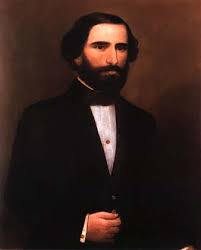
Giuseppe Verdi was born October 11, 1813. For his bicentennial year, I'm hoping to listen to one Verdi opera per day, in chronological order. I'll leave a few words about each on this blog, along with the recording I used. This is not meant to be musicological document. Just some impressions. I'd welcome your comments.


If you love Verdi, you should know the masterful biography by the late Mary Jane Philips-Matz.
What a pleasure to immerse oneself in this great composer.

Here are the first three:

Oberto, Conte di San Bonifacio (1839)
Temistocle Solera, Antonio Piazza
La Scala, Milan 1839
 
Carlo Bergonzi, Ruza Baldani, Rolando Panerai, Ghena Dimitrova/Lamberto Gardelli

A mash up of a plot, but an auspicious debut. Bartolomeo Merelli signed the young Verdi to a contract for three operas for La Scala, Milan. Oberto has a respectable success for a first-timer. Already it has some of the drama and the bite that differentiates the early Verdi form Donizetti, tho he as yet lacks Bellini's gift for melody and Rossini's sophistication. Still, this opera deserves an occasional revival. Wonderful tenor role.


Un giorno di regno ("A One-Day Reign") 1840
Felice Romani   La Scala, Milan  1840

Jose Carerras, Jessye Norman, Fiorenza Cossotto, Ingvar Wixell/Lamberto Gardelli

A comic opera and a flop. It sounds half-hearted, like a first draft that was never revised. This would be a good doctoral project, fixing it up and producing the opera at the College/Conservatory level. Verdi's wife and two children died of diphtheria while he worked on Un giorno. Verdi couldn't have been in the mood for this bubble of mistaken identity. The opera was finished  to complete a contract. It failed at La Scala and has been seldom revived. 


Nabucco
Temistocle Solera  La Scala, Milan 1842
Jan Dirksen, Pauline Tinsley, Jan Blinkhof, Hent Smit/Hans Vonk  The Netherlands, 1972

Now we're talking. Impresario Merelli used some tough love on the despairing Verdi. The result was the composer's first bona fide hit. The story of Nebuchadnezzar as told in the Old Testament. Verdi was tempted by the text of a chorus of displaced slaves. Va pensiero is to this day an unofficial national anthem. The vocal writing for Abigaille is deadly: up down, she enters on a low A, she goes up to a b flat. Nearly impossible to sing, the role derailed Giuseppina Strepponi in the first performances. Never mind. Verdi eventually married her. We begin to hear the energy that was the hallmark of Verdi's early operas. Try the Act I finale. Verdi has arrived.


Thursday, May 03, 2012

FALSTAFF at Ohio State

The School of Music at The Ohio State University presents Verdi's FALSTAFF in Mershon Auditorium, Friday May 4 at 8 pm and Sunday May 6 at 3. 

The production is staged by A. Scott Parry and conducted by Marshall Haddock. The costumes are by Christine Kearney.
Todd Thomas sings the title role, surrounded by a (wonderful) all student cast.

The Sunday performance is broadcast live on Classical 101.1 FM... on line at www.wosu.org/classical101
 
Falstaff by Gruzbeck
Falstaff! The final opera by Giuseppe Verdi. The composer was eighty years old at the opera's premiere at La Scala, Milan in 1893. He may have protested too much, crying "think to my age" when enticed by his librettist Arrigo Boito to end his career with comedy, and one of the composer's greatest loves, Shakespeare.

Verdi and Shakespeare were old friends. Macbeth was his first turn at the Bard, in 1847. The composer considered this opera a favorite child, revising it in 1865. To then end of Verdi's life there were hints at King Lear. In the past ten years scraps by Mozart, Beethoven and Schubert  have been found. Who knows what lie in the attic and cellars at Sant'Agata, Verdi's estate outside Milan?

Otello came forty years after Macbeth. Verdi had settled into a peaceful retirement, so he said. His letters at the time say he was content and finished with the theater. I don't buy it. The composer of Rigoletto, Il trovatore, La Traviata, Don Carlo (written for Paris) La forza del Destino (written for Russia) and even I masnadieri (written for London and Jenny Lind, no less) can't have been happy sitting watching the flowers grow, lovely estate or not.

Verdi (R) with Boito at Sant'Agata
Verdi and Arrigo Boito had met years before-the esteemed composer, a world celebrity, and an angry young man making his way at the expense his betters. A hot and heavy affair with Eleonora Duse gave Boito some social cachet. Boito's  relationship with Verdi grew into friendship with Otello. Boito's Italian language libretto has been called superior to Shakespeare's play (I ain't goin' there). Verdi's music was sensational. The opening storm choruses hav the audience reaching for rain gear to this day. There is no love duet more deeply moving than that between Otello and Desdemona at the close of Act I. The haunting kiss motive will come back, haunting indeed, at the end of the opera.

"Opera needs laughter as well as tears" Verdi said. His one comedy was his second opera, Un giorno di Regno (King for a Day)  written during a time of deep personal tragedy, nearly fifty years earlier. It seems that killing 'em off was more lucrative.  But there was Verdi, fresh from Otello's triumph, in his cool, dark rooms in Milan-applause ringing in his ears-leafing through Shakespeare. It was Boito who came up with the idea for Falstaff, helping himself to The Merry Wives of Windsor and Henry IV.

The French baritone Victor Maurel, Verdi's first Iago, put on the phony belly and took the title role at the premiere. Guess what? Maurel recorded Falstaff's little ditty from Act II, Falstaff's "seduction" of Alice 
Ford.

 When I was a pageboy to the Duke of Norfolk, I was so skinny, (sottile) I would slip through the ring on your finger!'

Here's Monsieur Maurel in 1907, six years after Verdi's death. He sing sit three times, being cheered on-and then once more, in French!


Here's more of that seduction. Silly Sir John has written the identical love letter to two ladies, Mrs. Ford and Mrs.Page.-the better to get more much needed pennies to finance his besotted lifestyle. The ladies get the joke and want revenge. Sir John ends up in a laundry basket thrown into the Thames


These clips are from the Metropolitan. Falstaff was first heard there with Victor Maurel, on February 4, 1895. W .J. Henderson in the New York Times:

Surely none left the auditorium without feeling that they had been in the presence of a masterwork, and one, too, little short of miraculous in its superb vitality, coming as it did, from the pen of a man who had passed the allotted three score and ten.

Falstaff has an adorable if naughty title character, the Merry Wives of Windsor, two young lovers, an angry husband and some creepy hangers-on. There's even kissing behind a screen, and a phony marriage in Windsor great park!

And all ends well. Verdi ends his operatic career with a magnificent fugue, as difficult to conduct as it is engaging to hear.Gone are the pyramids, and the hunchbacks, and the murderers and the tubercular heroines. Gone are the monarchs wanting to kill their sons and the sons wanting to sleep with their step mothers. What's left is 'Tutto nel mondo eburla"--All the world is a joke, wisdom is laughter: