Friday, June 01, 2007

WORLD WAR II: MY FATHER'S LETTERS

Curtis W. ("Bill") Purdy c. 1938

These are selections from letters written by my father while serving in the U.S. Army
during World War II.

Here's a quick bio:

Curtis W. Purdy ("Bill")
born February 4, 1919, Ithaca, NY

married Mary Duddy, April 16, 1955-Boston
one child, Christopher Curtis Purdy, born Boston December 2, 1956

Curtis died June 21, 1981 in Boston
Mary Duddy Purdy died April 10, 1986, Boston


Most of these letters were addressed to his mother, Florence L. (Curtis) Purdy
in Ithaca, NY.

Florence died in 1947.

Bill's father, Bert W. Purdy, died in 1953

Bill was the youngest child and had six sisters:


Elizabeth, Catherine, Ruth, Mary, Esther, Deborah

THE LETTERS:

August 8, 1944
England

Dearest Mother:

Have arrived in England safely and full of good old fighting spirit.
Mom, please do not worry a bit about me. I am sure the Good Lord above
will be with me and that he'll bring the end of this war soon.

I think the English are grand-the children are adorable and so brave.
As you know, the regulations of the mail are very strict and therefore I can
only say that I am happy and well.
Please send me some cigars and candy.
My every prayer is of you and your kindness you have shown to me.
Your ever loving son, Billy

______________________________________________________

August 11, 1944

Dear Mom:

Here I am again. Have been seeing some more of beautiful England.
There are so many quaint settings that I could write a book about them.

I'm listening to a broadcast of the Hit Parade and it seems as though I am way back in the living room hearing it. Frank Sinatra just finished singing 'San Fernando Valley'
He's now singing 'I'll be seeing you'.
Yes, I will be seeing you so I don't want you to worry a bit about me.

Mom, in order to send me things you will have to take this letter to the postmaster.
I want you to send me some cigars, cigarettes, candy, soap and razor blades.
If you send money, send it in a mail order.

There are some boys from the States in England from home and I hope to see them in time.
I hope and pray that this letter finds you well and happy.
Please Mom, don't worry about me, I'm all right.
Must say good night and God bless you and say hello to everyone for me.
All my love
Bill

_________________________________________________________________

August 27, 1944

Dear Mom:

I'm in rather a depressed mood today, wondering a lot of things
I'm lonesome for you and (???) like to see the rest of the folks.

I haven't had but one letter from you, so please write all you can and even though
I won't be writing so much myself, don't worry about it. I'm OK.

Was in a quaint town last night--had a swell time seeing the people, houses and landscape.
Went in the Red Cross and bought some coffee and doughnuts. Not much like the ones back home.

I understand its warm back in the States, but I guess summer here is really gone. How's Dad
and all the kids? Do you see Dad at all?

Mom, I need a billfold and identification bracelet so see if you can can send them.
Good night, Mom
Love
Billy

_________________________________________________________

August 31, 1944

Somewhere in England

Dear Mom

I guess I'm just an unlucky guy-I haven't heard from anyone in ages.
I've written to you all, several times at that.

I suppose you've all seen the news in the papers.

I continue to see the beauties of England. I occasionally see a nearby village and have a few of the famous bitters.

Mom, how's everything with you? See, I think of you so often and hope and pray that you are all right. As for me, I'll keep smiling.

Here I sit trying to write. I'm such a poor correspond. But my heart is full of thoughts and love for you! Say hello to all. Please send me some cigars, candy and razor blades.
Love, Billy

____________________________________________________________


September 4, 1944

Dear Mom:

I received your letter last night and I guess the boys thought I had lost my top, for it was the happiest day I've had since I've been here.

I'm so glad to know you are getting around so nicely.

Suppose you are getting the news of what's happening--it certainly looks good
I only hope I can meet some of my old buddies somewhere---Frink (?) came over with me but I haven't seen him since landing in England.

It's raining cats and dogs over here and reminds me of April back home.
Have you heard from Esther-I'm so anxious to hear from her.

Hope this letter finds you okay and happy.
Give my love to everyone and tell Dad to write.
Love
Billy

________________________________________________________________

October 9, 1944
Somewhere in France

Dear Mom

Its Sunday morning, a peaceful morning, one that has the---feeling of any normal one-behind this day tho, have been many hours of battling that has given me some exciting moments that I shall never forget.

Today I shall pray to God and thank him for the guidance he has given me. And I shall ask him for the courage and strength to go on forward to do my job well. I am grateful that I have been able to perform some worthy deeds-whatever the future holds for me, I hope that I can meet it like a man. This I will try to do for I know of the courageous boys who are with me and more than ever I am aware of my duty to them, which is to bring the wounded bodies back to our aid stations--then too, I have such people back home who are hoping and praying--I must not fail.

I wrote you a few days ago thanking you for the lovely Xmas present you sent me. Thanks a million again. I hope you got my present to you.

Mom, you must not worry about me, for I will be back home someday.
Please take good care of yourself.

Love
Billy

_____________________________________________________________
Bill in uniform, 1942
NOTE: Bill received a severe head wound in battle at the end of 1944.
He spent the next several months in hospitals in England and Luxembourg.
He had steel plates in his head for the rest of his life.
He was eventually awarded both the Purple Heart and Bronze Star.
______________________________________________________________

December 6, 1944

GERMANY

Dear Mom

Just wanted to let you know where I am. I am in Germany.
Mom, I can't tell you of the hectic time its been--words I'm sure could never tell the feeling that was in me--I was scared many times for it was my first real test of combat.

Mother I was sitting in a fox hole with a buddy when someone brought me your Christmas package. Needless to say it boosted my morale way up--there was peanuts, flashlight, candy, cigs, sewing kit and the bracelet-it was so sweet of you to send them and I love you so.

Mother, I'm with the grandest bunch of boys in the world. They are so brave and such great fighters, as the whole world will soon know.

You must not worry about me too much, for you know that I am here to help some of the
wounded men.

I'm not so sure of myself at times, but I've prayed so many times for the courage to do my job well. I pray that this war can end without much bloodshed.

Mother, I want to write on and on, but I must say good night for now.
You know my love for you is the strongest force I have.

I love you dearly.
Thank you again for the swell Christmas present.
Love
Billy

______________________________________________________________

January 29, 1945
Somewhere in Luxembourg

Dear Mom-

Sorry not to have written sooner. I wrote Deb last week. I've been in the hospital for a while but expect to be back to my organization shortly.

Before I went to the hospital I had made a fifty dollar money order out to you, but I won't be able to send it until I get back to my organization and get it from the mail clerk. I won't be paid this month, however I have some money loaned out to the fellows which should make me a nice sum when I call it in. I want you to use the money for yourself and get Dad whatever he needs
Haven't saved much, but I did put aside a hundred dollars last month. Maybe someday I'll be able to use it. It seems funny to be talking in terms of money, when so many boys have given their lives over here--I don't think a million dollars could erase the terrible experiences
that I've lived through. I only hope I can forget them.

The news of the Russian offensive is a wonderful thing. I hope that by the time this letter has reached you the fighting will be over. I'm anxious to get back to my outfit. They're the best bunch of boys in the world. Hope this letter finds you well and happy.

All my love
Billy

_________________________________________________________________

March 6, 1945
Somewhere in England
4116 U.S. Army Hospital

Dear Mom--

Here I am back in England--seems like I'm a million miles from the war.
I'm in a general hospital and getting along fine.

The countryside and the villages look almost like home as I rode by them.
Quite the changed from the ruined homes, cities and countryside back in France.
I wake up in the morning and I hear a kind of chirp, couldn't believe it at first--all I ever heard back in France were shells waking me up in the morning.

You can write to me with the above address instead of to my outfit. Please write quickly as I'm anxious to hear from you. Haven't heard from you in ages.

I'm not in much of a mood to write so please contact Dad and tell him that I'm thinking of him and do the same to Deb and her family. That's all for now.

All my love
Billy

_______________________________________________________________

March 19, 1945
4116 U.S. Army Hospital

Dear Mother-

Time just seems to fly and still I'm in the process of getting well. I wish I knew when I'd be out of here and my next move--guess I'll just have to hang around to find out.

I'm feeling fine these days, although I'm a little upset about what happened to the boys in my old gang-they were grand to me-They always wanted the "Doc" to have the best of everything.
It sort of haunts me to know that they are out there fighting and I'm back here in this warm, safe place--funny world, isn't it?

I haven't heard from you so please write soon. Pass the word around so I'll hear from the others, I hope and pray that all is well back home.
Love
Bill

Wednesday, April 25, 2007

WWW.WOSU.ORG/interviews

Please see this website.
I'll be adding new pieces each week.
Coming later today,a talk with
Robert Meeropol, the son of Julius and Ethel Rosenberg
and founder of the Rosenberg Fund for Children

www.rfc.org


Most recent: Norman Lebrecht

Later in April and May

Mike Farrell
Ruth Ann Swenson

So visit early and often!

www.wosu.org/interviews


Greetings to all

CP

Tuesday, March 27, 2007

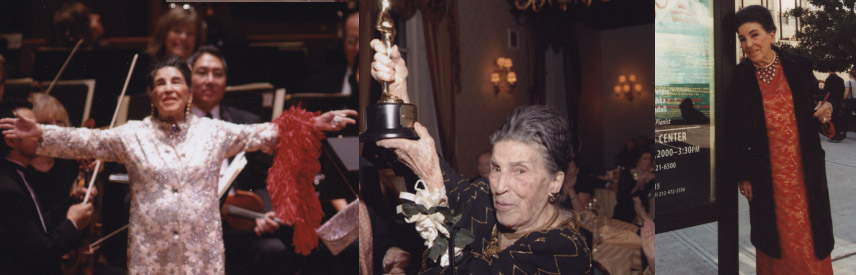
LICIA ALBANESE INTERVIEW

Soprano Licia Albanese sang Mimi in Toscanini's 1946 broadcast of La boheme and was his Violetta in La traviata. Mme Albanese gave over 400 performances at the Metropolitan between 1940 and 1966, and gave at least as many performances world wide. She recorded
La Boheme in Rome with Beniamino Gigli in 1939, and fifty years later was Heidi Schiller
in the New York Philharmonic's presentation of Sondheim's Follies. We spoke about Toscanini, and much more from her home in New York on March 26, 2007. Mme Albanese is a feisty and fully alert-to say the least- 94 year old. Today, she teaches and supports young artists through the Licia Albanese Puccini Foundation.
See also www.lapfny.org


NOTE: Pithy and clear she is but Mme Albanese is in her nineties and English is not her first langauge. This is a close but not perfect tracsription, with some omissions.
The entire audio interview will be posted at www.wosu.org/interveiws

CP: Welcome, Madame Albanese!

LA: Thank you

CP: When did you first meet Toscanini?

LA: I used to go to his concerts at NBC. I met him there. I went in the dressing room
to say hello to him. He was very happy to meet me. You know he never came to the Metropolitan because he had sometihng, I don't know. But I went to him and asked if I could go and see him. Then one day I was so surpised, Walter his son called and he said, Madame Alabanese my father wants to speak with you. You could imagine, I could faint! You can imagine! I said Maestro Toscanini to call me?! Certainly! With open arms!

CP: When you first met him you had already sung all over the world.
You had sung at Covnet Garden, Turandot
LA: Yes
CP: And you had recorded La boheme with Gigli
LA: Yes
CP: I think Toscanini heard you sining on the radio with the Met.
LA: You're right! You're right! he heard a Boheme...and then he chose me to do Boheme and then Traviata
CP: This was the 50th anniversay production of La boheme
LA: Yes
CPP: Jan Peerce was your tenor
LA: Yes...he was a very great companion and colleague , really kind. We sang a lot. And with Tucker. I thought Tucker's quality of voice was more beautiful than Peerce, but Peecre was fine, but the quality and beauty was Tucker for me. But with colleagues on stage, what we say
we move hands, we move the face, we move the eyes. Now you don't see on the stage anything, nothing.

CP: How did Toscanini compare with other conductors like Mitropoulos you sang with?
LA: Well, Mitropoulos was good. Listen, I sang a lot in Italy with Maestro Serafin.
I was very lucky to sing with the great condcutors. You remeber DeSabata, too.
I did Butterfly wih him. Very kind always. Never, never a condcutor was upset with anybody. Always with knindess. Even if young artist made a mistake, they always approached the artist withkindness

CP: Con amore...
LA: Si..Bravo! con amore!

CP: Ricordi piacere di Serafin, because people don't remember Serafin today
LA: Si, che peccato. He was great. He was all the time. He wanted young people to be known. He took us first to Rome, he took all the new singers to Rome with him.

CP: Did Toscanini have a temper?
LA: Let me think
CP: Because there are stories he would yell at the orchestra, and stamp his feet
LA: He would say IMBECILE! NBC! And I know you can do it he would say. I know you can do it. I have faith in you! But he had to have temper to have good things.
But he used to thank everybody at the end of the performance.
He was very kind. And he would thank us.
You know, Maestro Toscanini would come to the dressing rooms before we start to sing to wish good luck to us. I said, Maestro we should come to you, but he said no, no that's my duty to see all of my artists, that they are okay, and in good shape.
Just breathe before you come on stage. We Catholic would cross ourselves.
Then I would come running on stage like I still do!

CP: What did you think of Toscanini's tempi in Traviata and Boheme?
LA: Well, he told me, Licia this was when I knew the composer he wanted the sempre libera fast. It's nice! It's true! If you can do it, why you not do it?
(sings) Sempre libera follegiare...!
even the words they tell you have to do in a hurry.
My God, do you come to the Met to see the performances?
CP: Yes!
LA: What do you think?
CP: Sometimes a little boring
LA: Non c'e un cuore che parla....
CP: senza personalita!
LA: Si! senza passione
When I do the masterclasses now I say don't think! Make a mistake! Put your soul into the words. Don't do f-sharp, this...that. No! Don't think how high you go. Think on the words and then you can go in paradise...They tighten the throat. This is singing withToscanini and Serafin and all the great conductors. Even the conductor used to teach us vocally what to do.
Now they don't do anything. But the condcutors used to tell us to do more, to do more.
In Boheme with Toscanini, we had a Musetta, very good, nice voice , pretty girl but he would say "CER-ca CER-ca" and then one day after two or three days he said wha is this 'Cerca '(quacking) I want emotion. CER--ca!

CP: So emotion was very important to Toscanini?
LA: Very much. They teach emotion. Forget the notes. You make the voice more beautiful.
In masterclasses today I have to tell you, I make the most ugly voices beautiful voices with the words! With words you have beauty...You say CER-ca because she suffer too to see Mimi dying on the street

CP: Do you remeber a performance of yours that was your favorite?
LA: If was my favorite I would make it too long to sing it...All of it!
I sang in St. Louis too, Fedora...oh, listen I tell you. I did Fedora in St. Louis.
I have all the tapes, I'm telling you. I tell my son to put those tapes out. People can study

CP: You sang Adriana Lecouvreur
LA: I took over that from Tebaldi. Bing called me. And I was ready with everything.
I went to the Met. I dress up. They put pins in because Tebaldi was taller and I was a little short, but I made myself tall!

CP: I have your recording of the Adriana, and I have La rondine
LA: Si. With that beautiful , beautiful tenor. Who? Barioni. Beautiful.
And the scene we make together! Nodoby could tell me what to do on stage.
The tell me somebody else has to do. I said you don't know!
You don't do opera. Everyone comes in the opera to take over.
The people gets boring. You have to change.
I used to change every performance what I have to do.
Director now, and you can say this, they don't know the score. They don't know the books!
When the opera story written, that's why they make a mistake. They don't even know the score.

CP I know you didn't like Butterfly at the MeEt a few years ago
LA: Yes! Now I see the Met Madama Buterfly with puppets.
Can you believe that puppet when they put on the stage. ..
CP: Do you still go to the Metropolitan?
LA: No. No more. Non posso. Because one time I went and I booed.
I booed del Monaco. The son. He said well, I know you booed me. But I said Listen, but learn the opera! Like your father used to sing, he was so great. And he said Don't mention my father! I dont want to be known as son of my father!
But delMoncao how beautful he was on the stage. Every artist in my time has own costume.
Not the Metropolitan costumes. And the public was interested to come and say we want to see which costume you are going to put.....all the operas I sang, I change costumes...

CP: Did you have a favorite tenor? That's a bad question for a prima donna.
LA: To tell you the truth, no. They were all great!
First one was Gigli, in fact Gigli mention my name to Mr. Johnson. He was in search all the time young artists and Gigli mentioned my name. Licia is one of the great young sopranos to come to the Metropolitan.

CP: And he was right!
LA: Yes!
CP: The public alway knows
I thank you so much for your time
LA: Thank you very much. You are so kind. Big kiss! Ciao! ciao!

Thursday, March 22, 2007

FR. M. OWEN LEE ON EDWARD DOWNES

Father M. Owen Lee-how to describe him?
Professor of Classics at St. Michael's College, University of Toronto.
Baseball enthusiast. Film buff. Author.
Teacher. Metropolitan Opera broadcast shining light for many years.
Don't miss his books.
With Father Lee's permission I'm posting his remarks made on October 15, 1996
at a testimonial dinner for Edward Downes held at the Metropolitan Opera House.

This is from Father Lee:

Some of you here will know the sense of panic that takes over just before you go on the air with the Opera Quiz. After fourteen years of intermission appearances, I still ask myself, when that moment of silence descends on List Hall and we are poised to start, "Why am I doing this?"

Then I'd hear the voice long known to opera lovers across the length and breadth of the United States, Canada, and now Europe. Instantly recognizable. Part university dean, part kindly father. Wise as Sarastro though not so low in timbre. Warm as Hans Sachs but without the Weltschmerz. Sparkling as champagne in Fledermaus. No need to be unnerved. Edward Downes, the son of Olin Downes (who mastered the quiz when I first tuned in fifty five years ago) is seated professionally at a side table, with a stack of questions beside his microphone. The face that matches the familiar voice is positively beaming good will. He will see that everyone has a good time and no one comes to grief. And once you've answered the first question, the crisis is past.

I think I can say, without too much embarrassment, that I love this man. This wise and humble man who--one time when I was fogged in in Toronto and had sat up all night sleepless on a bus to get to New York and when, after two tough intermissions was on the brink of collapse--he took me up Broadway to his home in the Dakota, cooked me a meal, poured out the manzanilla (he likes Carmen), and started me on a stimulating exchange about our mutual enthusiasm, Wagner, and only then, when I was properly relaxed, sent me back to my hotel for a good night's sleep.

I want to tell you a story about the Dakota, where Mr. Downes lives at the very top, just above Yoko Ono, who can look from her window down on the strawberry fields she planted in memory of her husband, John Lennon, in Central Park.

When the Lennons wanted to move into the Dakota, the management told them that they first had to have a recommendation from someone already in residence. So the world famous Beatle phoned Mr. Downes and said, "We're musicians, too. Do you think you could recommend us?"

Mr. Downes explained, "Well, I'm not really acquainted with your work. But why don't you come over next Tuesday? We can meet, have tea, and perhaps then I can recommend you."

The Lennons said they would, and Mr. Downes promptly phoned his niece, of the newer generation, and said, "Dear, there are two young musicians coming to see me, and I'd feel much more comfortable with them if you were here and poured tea."

"Of course, Uncle Edward" came the reply. "Who are they?"
" I think he said his name was Lennon."

All the niece could say was, with some disappointment at her uncle's innocence, "Oh, Uncle Edward!"

The nicest thing about this story is that Mr. Downes told it about himself.

Thanks, Edward for teaching me to see deeply into operas I thought I knew. Thanks for your kindness, your wisdom, your wit, your encouragement, your professionalism, your love of music and of all good things. God bless you, and speed your new career on the broadcasts, for we sill have much to learn from you.

Fr. Owen Lee
October 15, 1996

Tuesday, February 27, 2007

STUDS TERKEL

I was fortunate to do a series of interviews with Chicago based broadcasting legend Studs Terkel (b.1912) in November, 2005. He had just published a terrific book, And They All Sang, a collection of interviews with figures in music going back fifty years. Terkel's interests over a long career ranged from politics and civil rights to jazz and opera. The Chicago Historical Society maintains a web site, www.studsterkel.com

Here are some selections from our talks

ROSA RAISA AND CARUSO

CP: I wanted to ask you about someone I know only from recordings and the history books. Rosa Raisa

ST: Oh! How do you know Raisa! You're the first person your age to know Raisa!
She was fantastic! She sang with Caruso. She came out of Eastern Europe, Bialystok, a little town that was decimated by the Nazis. She studied mostly in Italy. She had a voice that was so rich. Her Norma was fantastic, I would say better than Callas. The one memory that sticks in the mind is that when Puccini, who wrote Tosca and Madame Butterfly, when he was writing Turandot, he had her mind. Puccini died before he finished Turandot. So here's the opening night, and Puccini had died, and the opera hadn't been finished. Toscanini's at the podium and Raisa is singing this role created for her, and as soon as they came to the part where Puccini died, Toscanini put the baton down and turned and faced the audience and said, "At this point the maestro died", and he walked out.
There was another singer named Edith Mason who was very funny, and she and Raisa both described singing with Caruso. Caruso was of generous heart and spirit. He's the one who created the phonograph. There would have been no Victrolas without him.
His records were bought by immigrants who had very little money. They paid two bucks just him sing, two bucks! That fifty bucks today. But they both said he was so nervous, and he's give them a little shot of whiskey, which they wouldn't take but he would.
He said, I'm nervous because the audience wants 108 percent and I can only give 100 percent.
But he would go up and just as you'd think he's finished, he could go no higher out would come two or three more notes. He indicated what the human being could do.

Caruso's recordings are ninety and 100 years old and are readily available.
Has anyone ever heard a bad one? He died at forty eight in 1921.
Rosa Raisa's (1893-1963) biography by Charles Mintzer was published in 2001.
Her recordings are not plentiful and its said give only a hint of the magnificence of her voice.


CHICAGO

CP: What makes Chicago a great city?

ST:
I came here in 1920 as a little boy, an asthmatic little boy, 8 years old. And the minute I smelled those stockyards, I got over my asthma!
Chicago I found a very exciting place. Remember Carl Sandburg the great poet called it hog butcher of the world/center of wheat/son of railroads. That's all gone now. The stockyards have gone to the feed lots in New Mexico and Arizona. The railroads are gone. Nonetheless the skyscrapers by Louis Sullivan and Frank Lloyd Wright want to touch the heavens! Chicago is the city of horny handed people. Hands is an old fashioned word for working. And so they came from Eastern Europe. Chicago's Polish population is bigger than many cities, except for Warsaw. And they came from the Mediterranean, and from south of the Rio Grande, and now Asia, but Chicago' s hands mostly were builders, city workers. It had such quality. There are still the flat bungalows that somebody saved money for by working in the steel mills that are no longer here. What's happened to most cities has happened to Chicago too, losing so many landmarks. On an airplane now you fly over a city and you see golden arches and pizza places. You don't know what city you're in. Years ago I was traveling and I say to the switchboard operator in the motel, "Oh you gotta wake me up ans six o'clock in the morning, because I gotta be in Cleveland at nine. And she says to me, Sir, you ARE in Cleveland!" Chicago suffers from that but it still has that quality. Neighborhood is the key word. Chicago represents that. People came from the deep South. The sharecroppers used to hear that IC train...where's that goin'? It's goin' to Chicago!
There was a blues song, Jimmy Rushing who used to sing with Count Basie would sing: "Goin' to Chicago baby, sorry I can't take you" Well, even today the nature of the city, its impulse...still there!

RADIO GANGSTER

CP:
In one of your books, you write "I knew I had the makings of a good spectator.
What do you mean by that?"

ST:
I never dreamed I'd do stuff like talking to you on the radio and stuff. My dream as a depression child was of a civil service job, 9 to 5. I went to law school in Chicago, and I was dreaming of Clarence Darrow, and I wake up to Anthony Scalia! So that was enough for me! I became a disc jockey. First I was a gangster in radio dramas, and soap operas....Chicago was home of soap operas more than new York and Hollywood. Now they all were the same. Woman in White was about a nurse. The Guiding Light was about a minister. Mid Stream was about a doctor. But all the same scripts. I was always the same guy. They wanted a gangster,and I had a gangster voice. There were always three gangsters. The bright one, the middle one, the dumb one. I was always the dumb one.

CP: Did you get killed?
ST: Oh I always got killed! Well, sometimes you'd go to prison for life and that would be the end of it. I did another show called Mister First Nighter, out of the studios in the Wrigley building here in Chicago. The studio seats about 400 people, a live audience would watch us read scripts. Crazy! Then the told me, you gotta wear a tuxedo. I never owned tuxedo ! So I rented a tuxedo that night, very self conscious, and I walked down to the Wrigley building where I was going to play this gangster, and the guy hollers out, Mister First Nighter, Curtain Goin' Up! But he says you look just like a bookie goin to his sister's wedding! And I said that's exactly what I am, a bookie going to his sister's wedding! And I get killed before the first commercial.

CP: Did you always get killed before the first commercial?

ST: No. This happened a few times. Sometimes it was before the second commercial. I get killed or sent up for life. I made a living, sort of. And they guys in charge liked my style,a nd I became a disc jockey before that term was ever used.

MORE TO FOLLOW...see www.studsterkel.com


Thursday, February 15, 2007

MET GOES TO THE MOVIES: EUGENE ONEGIN and a MEMOIR...ROB BREEN AND BOSTON


The Metropolitan Opera presents an HD presentation of Tchaikovsky's Eugene Onegin
on Saturday, February 24th at 1.30 p.m. Go to www.metopera.org and click on the
Met Goes to the Movies Icon to find the theater nearest you.

Here in Columbus, Ohio, its the Regal Square Cinemas at 1800 Georgesville Road.
Dimitri Hvortsovsky sings the title role, with Renee Fleming as Tatiana, Ramon Vargas as Lenski-a role I've always wanted to do-and Valery Gergiev conducts.
There's not a ticket to be had for any of the performances in New York.
You wanna see this? Hie thee to a cinema near you.

I'm looking forward to this above all other such presentations, and the two I've seen have been wonderful. Onegin is a great favorite of mine. As I type these lines, I'm listening to a performance given in Boston's Symphony Hall in October, 1976. My roommate and good buddy Rob and I attended this via rush seats. Seiji Ozawa conducted the Boston Symphony. Rob is a clarinetist and his teacher, longtime BSO favorite Pasqule Cardillo (RIP) told him that Onegin was "Terrific. Long but terrific." I'm sure I found it long thirty years ago. I'm sure I found it terrific. I had never heard it before that night. To hear the Boston Symphony in Tchaikovsky's music, or anyone else's come to that, was/is a privilege. And the cast! Two people I had heard of thank you very much: The great tenor Nicolai Gedda, one of the finest artists I have ever heard sang Lenski. Onegin was sung by Benjamin Luxon, who was a BSO favorite in the 70s and he was fine. Tatiana? For shielding the writer Solzhentisyn, one of the greatest Russian artists, Mstislav Rosptropovich was thrown out of the country, stripped of all his honors and relegated to 'non person' status. Solzhenitsyn was stripped of citizenship, harassed an exiled, Nobel Prize and all. This was big news in 1976, as was the intervention of Senator Kennedy on his behalf. It was rumored Rostropovich would conduct this Onegin performance in Boston. He didn't, but Tatiana was sung by the Russian diva Galina Vishnevskaya...Mrs. Rostropovich. She was tremendous. A very beautiful woman, then in her fifties, the greatest soprano in Russia, for whom Britten wrote his War Requiem, for whom Shostakovitch wrote several great orchestral song cycles, her career came to a full halt because thirty years ago there wasn't much room in the west for a fiftyish Russian soprano who sang Tosca and Madama Butterfly in Russian (our loss) and thirty years ago Russian opera in the vernacular was rare in this country. But not in Boston in October, 1976.
Thrilling too was the Tanglewood Festival chorus! What a night!
I remember Rob and I shared a 'high'. He might not remember, but I do.

The story is based on the poem by Alexandr Pushkin (1799-1837).
As Alistair Cooke once described him, Pushkin "is to Russian literature what all of Shakespeare, Dickens, Thackeray, Melville and Thoreau are to the English speaking world". Onegin is the bored nephew of a wealthy landowner, who, through his friend Lenski is introduced into the Larin family. Lenski is engaged to the older daughter, Olga
("I haven't seen you for an entire day!"). Tatiana, the younger daughter, falls hard and at once for the aloof Eugene Onegin. She writes him a letter, pours it all out and is rebuffed by him for her pains. "You may regard me as a brother, but you should never share your heart, and certainly not with me , a stranger."
He takes her young feelings and tramples on them. Later, at Olga's name day celebrations, Lenski and Onegin quarrel, and Lenski provokes a duel, in which he is killed-Gedda was incomparable in this scene. Years pass. At a ball in St. Petersburg Onegin is welcomed by his elderly cousin, Prince Gremin. When introduced to Gremin's wife, the much younger Princess Gremina, Onegin realizes that this is Tatiana, and now he falls for her. But she dismisses him.
"I am a married woman. When once it was possible for us, you gave me only coldness." And Onegin is sent away.

Boris Goldovsky once told a story of a production of Onegin he staged in Boston,
fifty or so years ago. (This opera has good luck in Boston and I had the good luck to hear it there) Imagine Boris, conductor, producer and radio raconteur with a thick Russian accent
that years of living in Brookline, Massachusetts didn't erase.

"In the lest seen (last scene) Feelis Koortin
(Phyllis Curtin) as Tatiana came onstage on the arm of her husband, Prince Gremin.
She carried a fen (fan) and vore peenk flowers in her het (hat).
Now. Every Russian schoolchild knows that Tatiana at the ball enters waring red flowers in her het (hat)
When Feelis vore a peenk, het there vuz a gesp (gasp).
Mother, in ze frunt row, was greatly shocked at this!"

The opera is filled with spectacular choral scenes and waltzes and polonaises that always bring gasps of recognition from the audience (Rob gasped thirty years ago. "But I've played this!")
Tatiana's Letter Scene, the dances of Acts II and III, Lenski's aria at the duel and the great final confrontation of Onegin and Tatiana make this, not a Verdi opera, which it could have been, but a Russian sensation.

RECOMMENDED BOOKS

Any library will have Pushkin's verse novel Eugene Onegin
Don't miss Galya-the memoirs of Galina Vishneskaya.
This is nothing like a diva memoir, but a harrowing book about trying to be an artist in
the Soviet Union.

RECOMMENDED RECORDINGS
check out www.arkivmusic.com

Eugene Belov, Galina Vishveskaya, Sergei Lemeshev
Bolshoi Theare/Boris Khaikin

Mirella Freni, Thomas Allen, Neil Shicoff
Staatskapelle Dresden/James Levine

Friday, January 12, 2007

READ THIS: PETER SELLARS

Anyone interested in promoting the arts in this country should be sure to read Peter Sellars's key note address at the American Symphony Orchestra League Conference last June

www.symphony.org/petersellars.pdf

Provocative to say the least.

CP

Tuesday, January 09, 2007

MET GOES TO THE MOVIES: THE FIRST EMPEROR

Here in Columbus, OH:

Metropolitan Opera live in HD audio-visual
Saturday, January 13, 2006
1:30 p.m.
Georgesville Square Stadium 16
1800 Georgesville Sq.
Columbus OH

THE FIRST EMPEROR by Tan Dun

with Placido Domingo, Elizabeth Futral, Paul Groves, Suzanne Mentzer, Michelle DeYoung
condcuted by Tan Dun


Lots of people have been calling and e mailing since last Saturday's presentation of Bellini's
I Puritani. Now we share a brand new opera, in only its fifth perormance, Tan Dun's
The First Emperor. Born in China in 1957, Tan Dun is best known for his exhilirating score to the film hit Crouching Tiger, Hidden Dragon. Tan Dun himself conducts all performances of The First Emperor, and the entire run was sold out inNew York even before the first night!

Placido Domingo sings Emperor Qin, with a radiant new star, Elizabeth Futral as Princess Yueyang and the young American tenor Paul Groves as Gao Jianli. Fan Yue and Emi Wada make their Met debuts designing the sets and costumes for this production, and our stage directors are stars of thhe Chinese cinema: Zhang Yimou (Raise the Red Lantern) and Wang Chaoge.

Mr. Domingo is no tranger to new works. One of his first successes in New York was in the title role of Ginastera's Don Rodrigo at the New York City Opera forty years ago. Domingo's artistic integrity and his continuing box office clout made him an easy choice for the title role of
The First Emperor, which he adds to his repertoire of over 150 operas. The Metropolitan Opera has presented many world premieres in its 123 year history: Puccini's
La fanciulla del West (1910) and Il trittico (1918), Deems Taylor's Peter Ibbetson (1931)
Samuel Barber's Vanessa (1958) and Antony and Cleopatra (1966) to
Philip Glass's The Voyage (1992) and John Corigliano's The Ghosts of Versailles (1995).
New singers, conductors, directors and designers are awlays exciting but it is with new operas that this art form we all love so much continues to grow.

Check out www.metopera.org

Go to the Met web site for a fascinating blog, a diary kept during the rehearsal processs for
The First Emperor. Reviews came flowing in following the first night in Decmeber, and spicy they were. You can find them on line by searching The First Emperor along with the name of your favorite critic(!)

My favorites:

Martin Bernheimer, Financial Times, London
Alex Ross, The New Yorker
Peter G. Davis, New York
Manuela Hoelterhoeff, Bloomberg News Service

Make up your own mind by joining us on January 13th for The Met Goes to the Movies and
Tan Dun's The First Emperor.


THE

Tuesday, January 02, 2007

METROPOLITAN OPERA IN HD...SEEN AND HEARD IN COLUMBUS, OHIO!

The Metropolitan Opera's controversial revival of Bellini's I PURITANI
will be shown in HD video/audio live from the Metropolitan Opera House in Lincoln Center. Locally, you can see the Met live at REGAL GEORGESVILLE SQUARE STADIUM,
1800 Georgesville Road, about 10 miles from OSU. The date is Saturday, January 6. Showtime is 1.30. I'll be there for some pre peforamnce commentary at 1.15. Come say hello.

You'll find ticket info and more informaiton about these presentations at www.metopera.org
And check this blog every week.

Reports that the December 30th presentation of Mozart's MAGIC FLUTE (abridged) in Julie Taymor's staging played to packed movie theatres throughout the US are encouraging.
I PURITANI, one of the finest of all Italian language operas, might be a tougher sell. Come anyway. Here's why. Nobody who loves fine singing should give up a chance to hear this work "live". Bellini's long, grateful melodic lines, dependent upon the art of legato, are used to convey despair, joy, anticipation, worry....they take us way up and way down emotionally and are skillfully enough written so that a strong technique with a good top and a flexible voice should do very well.

I PURITANI (The Puritans)
music by Vincenzo Bellini (1801-1835)
libretto by Carlo Pepoli
first performance 1835

The story? Fasten your seats belts. Anna Russell couldn't have made this up:

We are in Plymouth, England immediately following the execution of King Charles I in 1649.
Mind you, everyone is dressed as British nobility or Puritans (Puritani) and everyone is singing I h0pe gloriously, in Italian.

Elvira is at last given permission to marry her beloved Lord Arturo, even tho her family is allied with Oliver Cromwell (the Puritani) and Arturo's with the nobility (Cavalieri). The marriage feast is interrupted by a mysterious veiled woman. This lady is Queen Henrietta Maria, the widow of Charles I--Lord Arturo gallantly spirits the queen away, leaving Elvira to believe he has abandoned her. She then goes mad. Literally. Mad scenes are an important part of the literature of Italian opera between 1820-1850ish. The most famous of such scenes, where the heroine's mind wanders while her voice has phenomenal demands made upon it, is that of Donizetti's Lucia di Lammermoor (1835), Donizetti's Anna Bolena (1831) and Rossini's Semiramide (1819) . Back to Puritani: Elvira recovers her reason, Arturo returns-in fact the sound of his voice snaps her back into reality. But sadly, Arturo is himself condemned to death for his successful rescue of the Queen. But this is opera! Ninety seconds before the final curtain word comes from London-they had fast horses in those days-that Arturo has been pardoned and he and Elvira, now recovered are free to marry. Tremendous finale roulades from Elvira, a few ecstatic notes above the staff from soprano and tenor and all ends well.

Mad scenes were a way with coping with female sexuality in the early Victorian era. Bellini's markings for a lot of his Puritani music 'con gran dolore' 'con tutta la forza d'emozione' 'giacoso vivamente'are deliberate. The point for heroine and hero is to display their longing for one another, in good times and bad-- in music. More precisely in song. Two hundred years ago you couldn't be seen wanting it or doing it but you could certainly sing about it. And in Puritani, the singing is often about nothing less than passion, misplaced, misdirected, or finally joyfully-reunited.

This Saturday you will see the sets and costumes designed for Dame Joan Sutherland and Luciano Pavarotti back in 1976. (My recent interview with Dame Joan is on this blog.)
This writer, a mere lad in '76 saw three performance of the run from standing room. Pavarotti was phenomenal as Arturo. Wig, lifts in his boots and all, he sailed forth with a high D at the end of the opera that had 'em roaring in the aisles. He waddled around and Dame Joan patted his tummy at the curtain calls. Dame Joan? A miracle. The most magnificent singer I ever heard live. The voice was larger, higher, stronger, and the coloratura more astonishing than anyone else, before or since. Did they act? No. Did they look the parts? Sutherland was fifty and Pavarotti was-well, Pavarotti. Did you care? Give me a break. Was the singing miraculous and was Bellini well served? Yes. I later splurged on the most expensive ticket in the house...$25!
The Met had been sold out for weeks but the lady at the box offic etold me, "Here's a $25 ticket. One of our subscribers died."

We'll be hearing Anna Netrebko as Elvira, hailed a "the Audrey Hepburn of opera". She's gorgeous with a lovely voice. Opera-l and the rest of the web has been abuzz a la scandale over the illness of tenor Eric Cutler and his replacement, Gregory Kunde who is apparently finding Arturo tough going. Pavarotti for all his splendor told the New York Times thirty years ago that he was terrified of singing Arutro, going so far as to share "I have the dirarrhea". I would be remiss if I didn't mention fine opportunities for lusty macho singing from the character of Riccardo (Sir Richard) Elvira's jilted Puritan suitor, and that of Giorgio, Lord Walton her benevolent Uncle. They were Sherill Milnes and James Morris in my day. You kids have no idea...

RECORDINGS:

Go whole hog. Sutherland and Pavarotti recorded this opera together..LONDON/DECCA

Maria Callas and Giuseppe di Stefano gave thrilling performances of I Puritani together in
Mexico City and Chicago. Callas is a very different phenomenon than Sutherland. She lacks Dame Joan's absolute dazzle. But nobody interprets Bellin's markings better than Callas.
She owned the role and her perforamnces in the fifties made possible Dame Joan's in the sixties, seventies and yes, eighties. Di Stefano sings voce aperto, with an opern throated excitement
that had him voicless by age 40 (Callas died at 53). He was a joy to hear in his brief prime.
Their recording is over fifty years old, and heavily cut. Still-it's Callas for God's sake! And the great Tullio Serafin condcuts. On EMI.


Thee's a two disc cheapie on Opera d'Oro of Callas and Di Stefano together in Mexico City in 1952-sound quality is terrible as are the orchestra, chorus and supporting players.
But those two are in glorious voice.

If you like I PURITANI, by all means listen to La sonnambula, Il pirata and above all, NORMA!

Next Met HD is Tan Dun's new opera THE FIRST EMPEROR with
Placido Domingo, Janaury 13th.

Tuesday, December 19, 2006

HOW TO GET BOOED AT LA SCALA

All the opera boards are clamoring about the incident last week at La Scala, Milan, when the tenor Roberto Algana was booed at the beginning of a performance of Aida, just after his difficult aria 'Celeste Aida'. Alagna, a decent French born tenor is a few sizes short of being a Radames, but I heard the previous performance on line and he sounded fine. This night however, as the booing began he flipped off the audience and walked off the stage. His understudy, in Reebok's and jeans walked out singing and the performance continued without a pause. Opera loves a good scandal and this one has some impressive mileage, thanks to the endless posts on opera-l and the event itself all over YouTube.

The consensus is Alagna behaved like a brat, and ultimately did himself no good. He's been fired from all the performances of Aida, and law suits and press conferences are flying back and forth all over Milan. Just before the third performance, from which he'd been fired remember, Alagna instead sang OUTSIDE La Scala to the amusement of the crowd who no doubt thought him just another panhandler, albeit better dressed.

Did anyone tell Robertino that everyone gets booed at La Scala?
The great tenor Carlo Bergonzi was booed thirty years ago, also in Aida. He too flipped off the audience but continued to sing.
By Act 3 the audience was screaming at him "Perdona Carlo! Bravo!"

And then there's Maria Callas.
Yeah I know we all talk about her too much.
Herbert Breslin is his loads of fun book about working with Pavarotti (The King and I)
says that EMI markets her recordings so aggressively and people buy 'em up so much that everyone's convinced she's still alive, and she'd been dead for thirty years.

Anyway, Callas was Queen of La Scala for years.
Not bad for a Greek girl from 178th Street and Amsterdam Avenue.
One night she was singing Medea. One of her signature roles.
She was in poor voice. The audience began to hiss. 4,000 people hissing.
Then the boos started. Callas came to the line in the opera that she was supposed
to address to Jason: "Crudel! Ha datto tutto a te!" Cruel one, I gave you everything.
What did she do? She ignored Jason, strode to the footlights, lifted her fist to the audience and sang that line in their faces. And the cheering went on all night.

That kids, is how you sing at La Scala.

Thursday, December 14, 2006

MESSIAH: Which to buy?

It's the time of year when many listeners call in saying, Y'know we just realized that we don't own a recording of Handel's Messiah-so which should we buy?
Yikes! How do you like your pizza? The choices are many and varied.
You can spend $5 and you can spend $50.
Here are some that I've enjoyed over the years.
amazon.com or arkivmusik.com should have these

In no particular order

The Robert Shaw Chorale and Orchestra, with Judith Raskin, Florence Kopleff, Richard Lewis and Thomas Paul. This was new to cd in 2005. It features the bracing, clear choral singing in the smaller forces we think Handel would have used (who really knows? everybody's dead)
and exemplary soloists, especially Richard Lewis and the sublime Judith Raskin. A 2 cd set at mid price.
RCA RED SEAL 82876-62317-2

Boston Baroque, conducted by Martin Pearlman, with Karen Clift, Catherine Robbin, Bruce Fowler and Victor Ledbetter. Pearlman's forces are similar to Shaw's in number, but he uses more appogiature and ornaments, again what Handel would have expected for a nice, varied sound texture, well recorded. A 2 cd set from TELARC, CD-80322

The Trinity Church Choir and Orchestra, Owen Burdick, conductor
Messiah had its first performance in the New World in 1770 at New York's Trinity Church,
near Wall Street. This recording was made there 225 years later. The vocal soloists are chosen among the members of Trinity's exemplary choir. This 2 cd set from Naxos (8.554511-2) is a fine performance, hard to pass up at a budget price.

Philharmonia Baroque Orchestra U.C. Berkeley Chamber Chorus, Lorraine Hunt Lieberson, Janet Williams, Patricia Spence, Drew Minter, Jeffrey Thomas, William Parker. This three cd package is set up in such a way that the listener may program one of several different versions of Messiah. It can all get a bit fussy and is not for the casual listener-its also expensive. BUT McGegan and his forces are magnificent musicians who for all thier pedantry don't forget that Handel himself called Messiah "an entertainment".

HERE ARE TWO MORE. NEITHER SHOULD BE YOUR ONLY RECORDING OF MESSIAH

Royal Philharmonic Orchestra and Chorus conducted by Sir Thomas Beecham, with Jennifer Vyvyan, Monica Sinclair, Jon Vickers and Giorgio Tozzi. This over the top orchestration by Eugene Goossens features large choral forces, no decorations whatsoever, and instruments Handel had never heard of. Saxophones, xylophones, they're all here. As far from the current Historically Informed Performances as you can get, this is the recording with which many of us grew up. Fantastic and musicologically wrong. There's a one cd of highlights available: RCA RED SEAL 9026-68159-2

English Chamber Orchestra, Ambrosian Singers conducted by Richard Bonynge with Joan Sutherland, Huguette Tourangeau, Werner Krenn and Tom Krause. This set attracted a lot of criticism when it came out in 1970. It is sumptuosly decorated, the choral work is clipping and fine, the orchestration is fussy, its fantastic to hear Joan Sutherland sing "Rejoice greatly o daughter of Zion!" and contralto Tourangeau is so awful she's fascinating. But I do love this performance. 2 cds on LONDON 433 740-2

Thursday, November 02, 2006

INTERVIEW WITH DAME JOAN SUTHERLAND

I was lucky enough to snag an interview yesterday with Dame Joan Sutherland,
on the phone from Sydney. Dame Joan celebrates her 80th birthday on November 7th.
Certainly she was an astonishing artist, one I heard many times dating back to 1970, and one I shall never forget.


The kindly press office at Opera Australia told me to call Dame Joan on November 1st at 4 p.m. my time. They must have told Dame Joan something else. Here's our conversation:

CP: Hello, this is Christopher Purdy from Ohio for Dame Joan Suth--
JS: You're a day late!
CP: Late? Uh...I'm sorry, I was told November 1st my time
JS: And today's the 2nd isn't it...and here you are
CP: Yes. I'm sorry. Can we speak now?
JS: Well, its a day late but go ahead.

At this point my trusty engineer was having trouble securing the connection for recording this interview. So now I'm a "day late" AND keeping Dame Joan Sutherland waiting on the phone. We do not do much small talk.

CP: Thank you for waiting, Dame Joan. We can begin now.
JS: Good!

CP: It is one of the great honors of my life to speak with Dame Joan Sutherland who is on the phone from her home in Sydney-welcome, Dame Joan

JS: Thank you very much!

CP: I know you were influenced early in your singing life by your mother. I wonder if you could describe your mother's voice.

JS: Well mother was a mezzo soprano and her teacher wanted her to go abroad and study in Paris and so on, but she said she was too nervous and didn't want a career and she didn't want all that. She wanted to go to the cricket matches and be with her friends and so on.

CP: Did you listen to her from her earliest childdhood?
JS: Oh yes, I used to sit at her feet and listen to her practise from the time I was quite small.

CP: Did she think you would have a great career?
JS: I don't think she imagined the success I eventually had, but she knew the material was there and she knew that it would mean a lot of hard work.

CP: Did your voice always have that trill and that agility?
JS: The trill was always there, yes. I never sort of pursued the agility so much.
I followed my mother who was a lyric mezzo. So I sort of put a lid on my voice because I wanted to sound like her.

CP: And I know that Kirsten Flagstad was a singer you greatly admired
JS: Oh I adored the voice of Flagstad. That was really an incredible person. And with a wonderful appearance when she sang -she was totally involved.

CP: Recently here at the station we played a recording of Lucia made in London in 1959-that was the production that brought you international fame. What do you remember about those performances?

JS: I have the feeling there's something wrong with the second part of the mad scene there. There's something wrong with transferring the tape-it's pitched too high
But the production was wonderful. Zeffirelli was the producer and Serafin conducted.
I just saw Lucia in Brisbane with my husband conducting up there. And the Australian
opera set was nearly a copy of that Zeffirelli set. Every single set I've worked in in Lucia over years, people remembered that Zeffirelli set and it's been re produced
so many times since 1959. And again in Brisbane it was very much that physical production except now it has someone else's name on it...

CP: I know that 1959 production in London was very important for you but it was important for Lucia ,too. The opera hadn't been done for a long time

JS: No, back then it hadn't been done in years

CP: Another opera I have great memoreis of your performances at the Met was Norma.
That's a pinnacle for so many artists and it was unforgettable then

JS: Well, it's an unforgettable opera. It's a great piece. It's probably one of my favorites, if not my favorite. That and Esclarmonde

CP: What makes Norma a favorite?
JS: I think she's a very recognizably human person, where some of the characters are rather cardboard

CP: How is it you sounded fresh at the end of Norma? That's a long sing
JS: Oh it has a few breaks in it. You learn how to sing it with confidence and you learn the pitfalls, and you get to be confident about singing the role.

CP: And Massenet's Esclarmonde-that was an opera nobody knew. I don't think it had been done since Sybil Sanderson-this great French Wagner pageant. It was a big hit

JS: It was terrific. And I was amazed when Decca decided to delete the recording. I thought that was ridiculous. I was amazed because it was the only recording of the piece. So I was hot on the telephone saying what on earth do you think your'e doing? Not because I'm singing but because it's the only recording of it.

CP: I think they listened to you because I saw it the other day

JS: Oh yes, now it has been repoduced many times over
CP: How did you ever find Esclarmonde?
JS: I didn't. My husband did. He read a lot about Massenet along with the Italian bel canto composers. And he read that Massenet thought it was his best work. He found tattered copies of the vocal score in Paris, and later was fortunate enough to buy the complete orchestral score when it came up for auction.

CP: One of my regrets is that I did not get to see you in Alcina
JS: That was a great piece. I loved all the Handel I did. Rodelinda, Julius Caesar.

CP: And what about singing today? What are you hearing? You told me you were at a big competition last night in Sydney.
JS: Very good voices! There were a lot of male voices. In fact there was only one woman last night. And I think Richard and I agreed on the winner. The young woman was quite good but the young man who won, from Western Australia, I think he'll do very well

CP: Are there specific young artists today you admire who you are following with interest?

JS: Well there are very good voices here certainly, but I don't follow it too much. I've had a few difficulties recently with arthritis, and just recently with knee replacement surgery. So I don't get about like I once did. So I tend to rely on recordings and television. I go when I can. I'm not that drawn to it I'm afraid. I don't like the producitons. I don't like all this updating and stagings that don't go along with the music

CP: Well, let's change the subject to something happier! How will you be spending your birthday?

JS: At home. A nice birthday lunch at home in Switzerland. Lots of things were on offer. One of our friends wanted to do a big party at his restuarant but we'll just be back from Australia. We're leaving on Friday-and Friday in case you don't know is tomorrow (laughs). But here we are. We finally made it!

CP: Touche! And I've waited all my life! (both laugh)

Do you realize how important your recorded legacy is?

JS: Well I mean I hear people saying they seem to play it everywhere. They take recordings with them and play them in the car. I'm very gratified that people enjoyed what I did. I wouldn't have lasted as long as I did if people hadn't enjoyed it.
It was great--Richard and I did a lot work on preparing the pieces. And I like to go along with him now and see what he's doing

CP: Where is Mr. Bonynge now?
JS: Right now he's upstairs, fast asleep!

CP: I want to wish you a happy birthday. Thank you very much-for everything.
JS: Well thank you, thank you for all your good wishes.

Wednesday, November 01, 2006

MARILYN HORNE AT OBERLIN 2006

Late October has come to mean Marilyn Horne's annual visit to Oberlin College.
If the beauty of the campus in mid fall tends to lull us into a happy stupor, the
energy of this lady-cetainly the greatest artist I ever heard live
(and I heard her a lot, praise God)is a terrific tonic.

Now in her seventies, Miss Horne looked great following a year battling health problems. She was radiant in attendance at the Florez recital that afternoon, and lavish in her praise of this great young singer. I remember a line from her memoir: "I've always been thrilled by great singing, period!" (Me too).

Miss Horne had been in Oberlin for several days of masterclasses and private coachings. I heard the last public masterclass, with an impressive crowd for a cold Sunday night. There were five students. All attractive, all musical and all blessed.

To a young soprano singing "Prendi, per me" from Donizetti's L'elisir d'amore:

Wonderful. Just great. I really don't have much to say.
Now listen. When you do that descent on 'prendi' the very first word.
Give me more D in prenDI. A little bite here is good.
Listen, you're an attractive girl. I want you to use that bod you've got!
Use your hands and your face.....OK. The coloratura needs more energy. You gotta pick it up a bit because the pitch will sag otherwise. Now look, you have a lovely voice. But I want you to sing louder. I don't mean to push or force in any way, but you are being a little too careful. Sing out.

(When she sang out it was a pealing, silvery voice. Exquisite)

To a young tenor singing Si ritrovarla from La Cenerentola

This young man met Juan Diego this afternoon. Juan Diego asked him what's your reportoire and I piped right up and said, "Yours!"
This was very good. But I want you to keep it Right Here..forward, in the mask-always. Especially with this, so much legato and then all that coloratura-you know I'm all about support. Your body has to work all the time, the entire body to provide the enrgy you need for this music.

(If this kid can bring some ring and support into his top notes, he'll go far. He's a baby still and his singing was mighty impressive)

To a young soprano singing Porgi amor from Le nozze di Figaro

Well! You have a very big voice, don't you? Wonderful. There aren't that many out there. But you are singing this too carefully. It's perfectly fine to sing this with a big voice. But use it....Oh, my I'm getting a wiggle in your voice. I think it's because you are holding back. Don't. Sing it. Also be very careful of your placement. C'mon...right here... right between the eyes. See? You sang out and no more wiggle. I want you to be very aware of that. You can fix it. Breathe low and support. You need to fill yourself with that good compressed air-and then keep feeding the breath slow and steady. Look, this is a difficult aria-its the first thing she sings and it must be rock steady. It's really all about technique. But with a big voice like yours
you really have to use it all-or else that wiggle. You can fix that. Your voice is wonderful!

A young man came out to sing Richard Strauss's Befreit. A long, higly emotional and dramatic lied. The voice was good and the musicianship very good. I'll bet Dieskau himself found this song a challenge. This young man was twenty-two. To him, Miss Horne said "Great. Wonderful. Just great. I really have nothing to say except congratulations!"

And last but not least, a young woman with another Strauss lied "Allerseelen". Her somewhat nasal production was attended to. Right here! A little higher, between the eyes. Miss Horne was big on using the entire body. No standing rock still for her.
You must engage everything. And very quickly, our Allerseelen artist came out with a march larger, warmer and rosy tone.
She also sang Allerseelen again, this time with real commtimewnt. In ten minutes there was a dramatic difference.

By this time it appeared Miss Horne was tired. It had been a long day. And certainly a wonderful day for music. The kung pao chicken at the local Chinese bistro wasn't bad either. And let me by all means acknowledge the gifted painists, Howard Lubin and Daniel Michalak, great musicans both, not fazed by anything, and totally in support of the young artists.

Now stop reading this and go play one of MArilyn Horne's recordings.

MARILYN HORNE AT OBERLIN 2006

Late October has come to mean Marilyn Horne's annual visit to Oberlin College.
If the beauty of the campus in mid fall tends to lull us into a happy stupor, the
energy of this lady-cetainly the greatest artist I ever heard live
(and I heard her a lot, praise God)is a terrific tonic.

Now in her seventies, Miss Horne looked great following a year battling health problems. She was radiant in attendance at the Florez recital that afternoon, and lavish in her praise of this great young singer. I remember a line from her memoir: "I've always been thrilled by great singing, period!" (Me too).

Miss Horne had been in Oberlin for several days of masterclasses and private coachings. I heard the last public masterclass, with an impressive crowd for a cold Sunday night. There were five students. All attractive, all musical and all blessed.

To a young soprano singing "Prendi, per me" from Donizetti's L'elisir d'amore:

Wonderful. Just great. I really don't have much to say.
Now listen. When you do that descent on 'prendi' the very first word.
Give me more D in prenDI. A little bite here is good.
Listen, you're an attractive girl. I want you to use that bod you've got!
Use your hands and your face.....OK. The coloratura needs more energy. You gotta pick it up a bit because the pitch will sag otherwise. Now look, you have a lovely voice. But I want you to sing louder. I don't mean to push or force in any way, but you are being a little too careful. Sing out.

(When she sang out it was a pealing, silvery voice. Exquisite)

To a young tenor singing Si ritrovarla from La Cenerentola

This young man met Juan Diego this afternoon. Juan Diego asked him what's your reportoire and I piped right up and said, "Yours!"
This was very good. But I want you to keep it Right Here..forward, in the mask-always. Especially with this, so much legato and then all that coloratura-you know I'm all about support. Your body has to work all the time, the entire body to provide the enrgy you need for this music.

(If this kid can bring some ring and support into his top notes, he'll go far. He's a baby still and his singing was mighty impressive)

To a young soprano singing Porgi amor from Le nozze di Figaro

Well! You have a very big voice, don't you? Wonderful. There aren't that many out there. But you are singing this too carefully. It's perfectly fine to sing this with a big voice. But use it....Oh, my I'm getting a wiggle in your voice. I think it's because you are holding back. Don't. Sing it. Also be very careful of your placement. C'mon...right here... right between the eyes. See? You sang out and no more wiggle. I want you to be very aware of that. You can fix it. Breathe low and support. You need to fill yourself with that good compressed air-and then keep feeding the breath slow and steady. Look, this is a difficult aria-its the first thing she sings and it must be rock steady. It's really all about technique. But with a big voice like yours
you really have to use it all-or else that wiggle. You can fix that. Your voice is wonderful!

A young man came out to sing Richard Strauss's Befreit. A long, higly emotional and dramatic lied. The voice was good and the musicianship very good. I'll bet Dieskau himself found this song a challenge. This young man was twenty-two. To him, Miss Horne said "Great. Wonderful. Just great. I really have nothing to say except congratulations!"

And last but not least, a young woman with another Strauss lied "Allerseelen". Her somewhat nasal production was attended to. Right here! A little higher, between the eyes. Miss Horne was big on using the entire body. No standing rock still for her.
You must engage everything. And very quickly, our Allerseelen artist came out with a march larger, warmer and rosy tone.
She also sang Allerseelen again, this time with real commtimewnt. In ten minutes there was a dramatic difference.

By this time it appeared Miss Horne was tired. It had been a long day. And certainly a wonderful day for music. The kung pao chicken at the local Chinese bistro wasn't bad either. And let me by all means acknowledge the gifted painists, Howard Lubin and Daniel Michalak, great musicans both, not fazed by anything, and totally in support of the young artists.

Now stop reading this and go play one of MArilyn Horne's recordings.

JUAN DIEGO FLOREZ AT OBERLIN

Sunday, October 30, 2006

Juan Diego Florez sang a recital at Oberlin College's Finney chapel today to a cherring, stamping, shouting crowd the like of which I haven't heard since the autumnal days of Callas and Tebaldi. The difference was, as Marilyn Horne commented later "You are hearing a magnificent artist in his absolute prime with all engines running and everything working."

Florez had an ingratiating "aw shucks" stage demeanor, endless legato, perfectly placed coloratura-no machine gun apsirating here-and ringing high Cs
(and Ds, thank you very much). Tonio's aria from Fille du regiment was the first of three encores!

The program opened with three Mozart arias: from Die Zauberfloete, Il re pastore and Il mio tesoro (Don Giovanni).
The tone was evenly porduced and the languages sung with undertanding and love. Il mio tesoro ran on with the elegance and effortlessness heard on the classic John McCormack recording made ninety years ago. There were Rossini arias from Il turco in Italia and Elisabetta d'Inghliterra. In this last Florez any semblance of youth and humor and became a warrior.There were luscious Peruvian songs, and an exquisite "Ouvre tes bleu yeux" by Massenet, which was all about line. Refreshingly, Florez ended the printed program with a contemplative aria from Donizetti's Linda di Chamonix.

Florez's stage presence sometimes threatened to induce sea sickness-he's a bopper and weaver-but to see this wonderful looking young man sing his heart out so thrillingly, well-like the song says, "I'll tell my grandchildren."

Encores: Ah, mes amis; La donna e mobile and one more Latin song.
The audience would have kept him all night.
This was first rate bel canto. Pianist Vincent Scalera matched Florez note for note for energy and elegance.

Not even the death of my van in the Oberlin parking lot at 11 pm-which had to be towed to Columbus ($377.88!) at 3 a.m. spoiled the sound of that wonderful singing and playing still ringing through my sleepy ears.

Monday, October 02, 2006

SISTER ANGELICA

Giacomo Pucini 1858-1924
I've been offered a wonderful opportunity this fall to direct most of Puccini's one act opera 'Suor Angelica'. I say "most of" because we're doing the second half. At one hour the whole is too long for a scenes recital. Performance date is November 21. Now, a nice Irish boy like me from Boston with a sentimental streak a mile wide may or may not be the best choice to handle this delicate work.

It's the story of a Florentine princess who is put away in a convent by her outraged family after bearing a child out of wedlock. One day, after seven years of silence the princess-now "Sister Angelica" is visited by her forbidding, elderly aunt. The old lady has no compassion for her niece. She has come only to obtain a signature from Angelica who is told to renounce all claims to her family's estate in favor of her younger sister, who is about to be married


ANGELICA: After seven years I stand before you
Let this holy place inspire you
It is a place of pity, a place of forgiveness

AUNT: A place of penance!

Your sister Anna Viola is to be married

ANGELICA: Married? Little Anna Viola, married?
My little sister-Oh, seven years have passed
Who is she to marry?

AUNT: To one whose love has allowed him to overlook
the disgrace you have brought to our noble family

ANGELIA: Sister of my mother-you are unforgiving!

Angelica signs. She asks timidly the fate of her young son.

AUNT: Two years ago he was taken ill.
Everything was done to try and save him

The child is dead. The old lady leaves without a word of kindness.
Angelica brews herself a tea of poisoned herbs.
In drinking this she realizes she has committed the mortal sin of suicide.
She manages to pray to the Virgin for forgiveness.
She dies with a vision of the virgin leading her young son toward her.


ANGEICA MAdonna, madonna salvami
Per l'amor di mio figlio
ho smarie la ragioe!

Save me, Madonna
For the love of my son
I have lost my reason

Well, now. That can be pretty hokey even for me!
I remember every Easter as a kid sitting through "The Song of Bernadette" on TV and by 11 pm Jennifer Jones would be on her deathbed crying "I really did see her! I really did see her!" and dying as MGM's chorus of off camera angels switch from a minor to a major key for the end credits.

(You should always die in a major key)
Giacomo Puccini, world famous for La boheme, Tosca and Madama Butterfly, had a notable success at the Metropolitan Opera in New York with his La fanciulla del West The Girl of the Golden West in 1910. The saloon keeper Minnie, the 'girl' of the title was sung by Emma Destinn. Enrico Caruso played the cowboy bandit Dick Johnson.   La fanciulla del West  was recognized as Puccini's most sophisticated score-if not most loved-only after his death in 1924.

Still, with Richard Strauss, Giacomo Puccini was the world's greatest opera composer. By 1918 it was time to return to the Met, and try again.

We come to the world premiere of  Il trittico at the Met, December 14, 1918.


Suor Angelica was not a success at its premiere. It is the second of three operas written by  Puccini intended to be performed on the same evening as Il trittico-The Triptych. The first, Il tabarro-The Cloak is a steamy sex and blood and guts shocker...and the third is Puccini's only comedy, the wonderful "Gianni Schicchi".


But Sister was left alone and unloved on and off the stage.

Here's a review of the first night by the critic W.J. Henderson:

There is dignity unalloyed, majesty untempered, reverence unlimited in "Suor Angelica." There are
Geraldine Farrar
conscious efforts to lighten the score by the introduction of trivial incidents-the arrival of a stock of good food into the nunnery courtyard or the scramble to pluck at raspberries-and here the music is highly ingenious.
But it is almost always metronomic, dull, drilling upon its theme with the persistence of a dentist at a tooth. There is no blood or bone to it, no strength to uphold the nun's veiling of the concept.

Miss Geraldine Farrar deserves all credit for what good impression the short tragedy made. Her acting of the nun who has endured seven years of vindictive loneliness, who learns of her child's death, who brews and drinks a fatal cup, and prays for a miracle to prove the Madonna's forgiveness-her acting of all this lugubrious fustian was magnificently noble.
 Her voice was by no means at its best, but she carried the role and the audience equally far. The miracle proved a tame affair. To a Metropolitan clientele on familiar terms with miracles...this one had the taint of much modesty.-

WJ HENDERSON, NEW YORK SUN, Dec. 16, 1918

I think writing such an opera for an important premiere in New York may have been a mistake. The Metropolitan Opera must have glittered on December 14,1918. Puccini was the world's most celebrated opera composer. He had visited New York ten years earlier to supervise the local premiere of Madama Butterlfy." His delicate geisha-needing lungs of steel to sing over his large orchestra-was the American glamor girl Geraldine Farrar (1882-1967). Puccini reportedly did not like her but that hardly mattered. Lovely of voice and figure, Farrar -the daughter of a baseball player from Melrose, Massachusetts, was the darling of the public, second only to Caruso in box office popularity. She had the further advantage of being Arturo Toscanini's mistress. Conductor and diva began as sworn enemies at early rehearsals

FARRAR: Do not correct me, Maestro.
Remember, I am a star

TOSCANINI: Signora the only stars are in the heavens.
On the earth there are only good artists or bad artists
You are a bad artist

By 1918 Farrar had gone Hollywood, becoming a bona fide movie star-playing everything from Carmen to Joan or Arc-and Toscanni had left the Metropolitan.

No doubt she was chosen for Suor Angelica for her box office clout. Farrar herself seemed unimpressed by the opera. She wrote later "Suor Angelica made no demands on me". HMMMM


I doubt the New York public found the glamorous Geraldine, who counted the Crown Prince of Prussia among her lovers, a convincing nun. She recorded no music from this opera. She sang a dozen performances of Angelica from 1918 to 1921.

The opera was not given again at the Met until 1975. Il tabarro and Gianni Schicchi managed to hang on.

In Vienna, Schwester Angelica became the property of the great Lotte Lehmann, who was not the looker Farrar was, but Puccini called Lehmann's performance 'soavissima'.


Is Suor Angelica a bad opera? No.

I'm willing to bet that the first audience nearly 90 years ago was cynical enough to laugh at visions of the Virgin Mary walking around on stage. The all female cast may have been aurally monotonous.
Opera demands that audiences and performers ignite their imaginations and leave cynicism at the door. Doing that is made easier when the stories are dramatic, when audiences are lulled or manipulated into some kind of strong emotional response. Wagner does this through his music. Verdi through his music and situations. Puccini comes across as unashamedly sentimental. Everyone cries when Mimi dies at the end of La boheme. Cops, prize fighters and even Republicans leave the theater weeping.


OK, the Virgin Mary might be a bit much-but what helps Puccini along is the utter sincerity with which he depicts his characters. He's been the step child of the critics for one hundred years. But we believe in his operas and his creations because he does. If there's any cynicism in the theater, its off stage and off the printed page. Puccini meant to tell the tragedy of a woman who has lost her baby and who seeks redemption and he did so.

But there's a complication. For all her gentleness, Angelica's music demands a dramatic soprano voice, with the beauty of a waterfall and the strength of a cement mixer.

You may wish to play this opera as a blushing flower but the music doesn't support you. Convents were houses of prayer yes, but they were also as with Angelica prisons for fallen women or women whose families could not marry them of advantageously. They were places of anger, petty jealousies, sexual confusion and divine grace. Angelica has tried to live a serene life for seven years, keeping her pain and loss wrapped tightly inside of her. What toll does that take on any of us? How many of the older nuns, who have presumably been there for years-are actually serene and at peace.

Would pretty music serve them? The other sisters, must be made individual characters. Their music is not especially flavorful but the sternness of the Sister Monitor means that Sister Dolcina's funny gluttony and Sister Osmina's defiance must be brought out to balance Sister Genevieve's youth and naivete and Angelica's pain. These are supporting roles but the opera will not function at all if they are not played well. Likewise the Aunt, la zia principessa is less interesting played as a harridan rather than a woman who wants to be past the pain of life, and for whom her niece Angelica, whom she cannot forgive, is a symbol of that pain.

I don't think the music is monotonous. I think it reflects the tedium and pain many of the sisters found in their daily lives. Farrar didn't get it. I doubt she wanted to. Her recordings of music from Tosca and La boheme are marvelous. She "owned" Madama Butterfly whether Puccini-or Toscanini- liked her or not. She may have played Angelica's supposed timidity too well, or over played it. And I doubt she had the voce di petto-the growling dramatic chest voice Angelica needs when she rebukes her aunt, her one act of defiance in this fifty minute opera

ANGELICA
Sorella di mia madre, voi siete inesorabile
Sister of my mother, you are unforgiving

********************

Perche tacete?
Un altro istante di questo sileznio
e i dannate per l'eternita!
Le vergine vi acolta e Lei vi giudica

Why are you silent?
Another moment of this silence
and you will be damned forever
The virgin hears you, and judges you

Renata Tebaldi, recording only. Troppo emozione!
Even Renata Tebaldi, surely the most glorious Italian soprano voice of the past fifty years,  never sang Angelica on the stage. "Troppo emozione" she said. Her 1962 recording of the opera finds Tebaldi in poor voice, ducking the one high C-never a good note for her anyway.


Renata Scotto gave memorable performances in the 1980s.

We laughed then at her fractured voice and dramatic excess and we miss her now.
She probably made us uncomfortable with her honesty. Callas never attempted Suor Angelica. Its a vocal and emotional wallop balanced by a delicacy that's hard to pull off. Angelica has to seem to want to explode emotionally while almost never doing so. She is a destroyed woman playing a contented woman.


And she needs a big, luscious, gleaming voice.

Thursday, September 21, 2006

LONG HOT SUMMER-DICHTERLIEBE RECORDINGS

Actually there was quite a lot going on this summer I could have posted about, but Luddite that I am I forgot both password and user name and whatever else one needs to climb the cyber walls back into the blogosphere. I think I'm okay now.
I'm doing pre cocnert talks here in Columbus OH to everyone and their mother. I tell poeple if you don't like me go on and have another booter and come back later.

DICHTERLIEBE

Earlier this year I kept a diary while preparing Schumann's Dichterliebe with my friend Ben. We were doing this as a challenge from a local church that dared us to prepare this for one of their lunch hour concerts. I meanpeople would actually ATTEND! We cancelled the church, sang it at a Women's Club and now the church gig is on for October 3rd. As usual I've been comparing a buttload of recordings...six by Dieskau...Fritz Wunderlich, a little bland but sublime, Aksel Schiotz with Gerald Moore, fantatic and my two favorites, Lotte Lehmann with Bruno Walter (1940) and Charles Panzera with Alfred Cortot. I love Lehmann's guts- hearts on sleeve out there brilliance. With Panzera, it is all about the words. His graceful and very subtle use of rubato goes right to my heart. For me, its an experience at tackling a great work with a great friend for nice people. The spirit is willing and eager, and if the pipes never were there, well, it'll be a day out at least. Stay tuned.

Wednesday, June 28, 2006

MORE THAN MUSIC 101

Join me for six two hour explorations of music
from the 14th century to the 21st, with stops along the way to disucss performance
practise-why adagio meant something different 400 years ago than it means today-
artists, style and most importantly the day to day lives composers and the historical ontext in which many of our greatest works were created.

It'll be a combination of good informaiton, some listening, and stand up.

MORE THAN MUSIC 101

Wed. July 19th
Thu July 27
and

Wednesdays August 2, 9, 16 and 23

7-9 p.m.
ST JAMES CHURCH
3400 Calumet St. @ Oakland PArk
Clintonville
plenty of free off street parking

$200--

Please RSVP to christophercpurdy@yahoo.com