Follow by Email

Tuesday, March 27, 2007

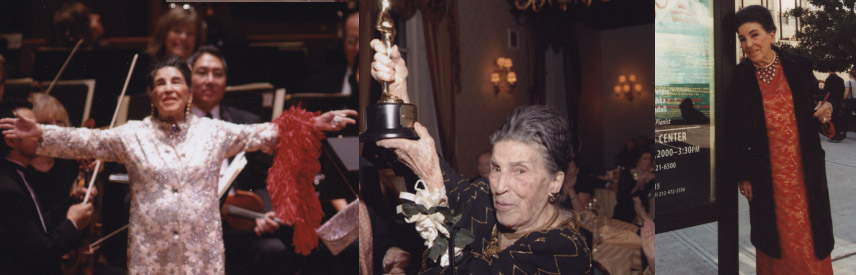
LICIA ALBANESE INTERVIEW

Soprano Licia Albanese sang Mimi in Toscanini's 1946 broadcast of La boheme and was his Violetta in La traviata. Mme Albanese gave over 400 performances at the Metropolitan between 1940 and 1966, and gave at least as many performances world wide. She recorded
La Boheme in Rome with Beniamino Gigli in 1939, and fifty years later was Heidi Schiller
in the New York Philharmonic's presentation of Sondheim's Follies. We spoke about Toscanini, and much more from her home in New York on March 26, 2007. Mme Albanese is a feisty and fully alert-to say the least- 94 year old. Today, she teaches and supports young artists through the Licia Albanese Puccini Foundation.
See also www.lapfny.org


NOTE: Pithy and clear she is but Mme Albanese is in her nineties and English is not her first langauge. This is a close but not perfect tracsription, with some omissions.
The entire audio interview will be posted at www.wosu.org/interveiws

CP: Welcome, Madame Albanese!

LA: Thank you

CP: When did you first meet Toscanini?

LA: I used to go to his concerts at NBC. I met him there. I went in the dressing room
to say hello to him. He was very happy to meet me. You know he never came to the Metropolitan because he had sometihng, I don't know. But I went to him and asked if I could go and see him. Then one day I was so surpised, Walter his son called and he said, Madame Alabanese my father wants to speak with you. You could imagine, I could faint! You can imagine! I said Maestro Toscanini to call me?! Certainly! With open arms!

CP: When you first met him you had already sung all over the world.
You had sung at Covnet Garden, Turandot
LA: Yes
CP: And you had recorded La boheme with Gigli
LA: Yes
CP: I think Toscanini heard you sining on the radio with the Met.
LA: You're right! You're right! he heard a Boheme...and then he chose me to do Boheme and then Traviata
CP: This was the 50th anniversay production of La boheme
LA: Yes
CPP: Jan Peerce was your tenor
LA: Yes...he was a very great companion and colleague , really kind. We sang a lot. And with Tucker. I thought Tucker's quality of voice was more beautiful than Peerce, but Peecre was fine, but the quality and beauty was Tucker for me. But with colleagues on stage, what we say
we move hands, we move the face, we move the eyes. Now you don't see on the stage anything, nothing.

CP: How did Toscanini compare with other conductors like Mitropoulos you sang with?
LA: Well, Mitropoulos was good. Listen, I sang a lot in Italy with Maestro Serafin.
I was very lucky to sing with the great condcutors. You remeber DeSabata, too.
I did Butterfly wih him. Very kind always. Never, never a condcutor was upset with anybody. Always with knindess. Even if young artist made a mistake, they always approached the artist withkindness

CP: Con amore...
LA: Si..Bravo! con amore!

CP: Ricordi piacere di Serafin, because people don't remember Serafin today
LA: Si, che peccato. He was great. He was all the time. He wanted young people to be known. He took us first to Rome, he took all the new singers to Rome with him.

CP: Did Toscanini have a temper?
LA: Let me think
CP: Because there are stories he would yell at the orchestra, and stamp his feet
LA: He would say IMBECILE! NBC! And I know you can do it he would say. I know you can do it. I have faith in you! But he had to have temper to have good things.
But he used to thank everybody at the end of the performance.
He was very kind. And he would thank us.
You know, Maestro Toscanini would come to the dressing rooms before we start to sing to wish good luck to us. I said, Maestro we should come to you, but he said no, no that's my duty to see all of my artists, that they are okay, and in good shape.
Just breathe before you come on stage. We Catholic would cross ourselves.
Then I would come running on stage like I still do!

CP: What did you think of Toscanini's tempi in Traviata and Boheme?
LA: Well, he told me, Licia this was when I knew the composer he wanted the sempre libera fast. It's nice! It's true! If you can do it, why you not do it?
(sings) Sempre libera follegiare...!
even the words they tell you have to do in a hurry.
My God, do you come to the Met to see the performances?
CP: Yes!
LA: What do you think?
CP: Sometimes a little boring
LA: Non c'e un cuore che parla....
CP: senza personalita!
LA: Si! senza passione
When I do the masterclasses now I say don't think! Make a mistake! Put your soul into the words. Don't do f-sharp, this...that. No! Don't think how high you go. Think on the words and then you can go in paradise...They tighten the throat. This is singing withToscanini and Serafin and all the great conductors. Even the conductor used to teach us vocally what to do.
Now they don't do anything. But the condcutors used to tell us to do more, to do more.
In Boheme with Toscanini, we had a Musetta, very good, nice voice , pretty girl but he would say "CER-ca CER-ca" and then one day after two or three days he said wha is this 'Cerca '(quacking) I want emotion. CER--ca!

CP: So emotion was very important to Toscanini?
LA: Very much. They teach emotion. Forget the notes. You make the voice more beautiful.
In masterclasses today I have to tell you, I make the most ugly voices beautiful voices with the words! With words you have beauty...You say CER-ca because she suffer too to see Mimi dying on the street

CP: Do you remeber a performance of yours that was your favorite?
LA: If was my favorite I would make it too long to sing it...All of it!
I sang in St. Louis too, Fedora...oh, listen I tell you. I did Fedora in St. Louis.
I have all the tapes, I'm telling you. I tell my son to put those tapes out. People can study

CP: You sang Adriana Lecouvreur
LA: I took over that from Tebaldi. Bing called me. And I was ready with everything.
I went to the Met. I dress up. They put pins in because Tebaldi was taller and I was a little short, but I made myself tall!

CP: I have your recording of the Adriana, and I have La rondine
LA: Si. With that beautiful , beautiful tenor. Who? Barioni. Beautiful.
And the scene we make together! Nodoby could tell me what to do on stage.
The tell me somebody else has to do. I said you don't know!
You don't do opera. Everyone comes in the opera to take over.
The people gets boring. You have to change.
I used to change every performance what I have to do.
Director now, and you can say this, they don't know the score. They don't know the books!
When the opera story written, that's why they make a mistake. They don't even know the score.

CP I know you didn't like Butterfly at the MeEt a few years ago
LA: Yes! Now I see the Met Madama Buterfly with puppets.
Can you believe that puppet when they put on the stage. ..
CP: Do you still go to the Metropolitan?
LA: No. No more. Non posso. Because one time I went and I booed.
I booed del Monaco. The son. He said well, I know you booed me. But I said Listen, but learn the opera! Like your father used to sing, he was so great. And he said Don't mention my father! I dont want to be known as son of my father!
But delMoncao how beautful he was on the stage. Every artist in my time has own costume.
Not the Metropolitan costumes. And the public was interested to come and say we want to see which costume you are going to put.....all the operas I sang, I change costumes...

CP: Did you have a favorite tenor? That's a bad question for a prima donna.
LA: To tell you the truth, no. They were all great!
First one was Gigli, in fact Gigli mention my name to Mr. Johnson. He was in search all the time young artists and Gigli mentioned my name. Licia is one of the great young sopranos to come to the Metropolitan.

CP: And he was right!
LA: Yes!
CP: The public alway knows
I thank you so much for your time
LA: Thank you very much. You are so kind. Big kiss! Ciao! ciao!

Thursday, March 22, 2007

FR. M. OWEN LEE ON EDWARD DOWNES

Father M. Owen Lee-how to describe him?
Professor of Classics at St. Michael's College, University of Toronto.
Baseball enthusiast. Film buff. Author.
Teacher. Metropolitan Opera broadcast shining light for many years.
Don't miss his books.
With Father Lee's permission I'm posting his remarks made on October 15, 1996
at a testimonial dinner for Edward Downes held at the Metropolitan Opera House.

This is from Father Lee:

Some of you here will know the sense of panic that takes over just before you go on the air with the Opera Quiz. After fourteen years of intermission appearances, I still ask myself, when that moment of silence descends on List Hall and we are poised to start, "Why am I doing this?"

Then I'd hear the voice long known to opera lovers across the length and breadth of the United States, Canada, and now Europe. Instantly recognizable. Part university dean, part kindly father. Wise as Sarastro though not so low in timbre. Warm as Hans Sachs but without the Weltschmerz. Sparkling as champagne in Fledermaus. No need to be unnerved. Edward Downes, the son of Olin Downes (who mastered the quiz when I first tuned in fifty five years ago) is seated professionally at a side table, with a stack of questions beside his microphone. The face that matches the familiar voice is positively beaming good will. He will see that everyone has a good time and no one comes to grief. And once you've answered the first question, the crisis is past.

I think I can say, without too much embarrassment, that I love this man. This wise and humble man who--one time when I was fogged in in Toronto and had sat up all night sleepless on a bus to get to New York and when, after two tough intermissions was on the brink of collapse--he took me up Broadway to his home in the Dakota, cooked me a meal, poured out the manzanilla (he likes Carmen), and started me on a stimulating exchange about our mutual enthusiasm, Wagner, and only then, when I was properly relaxed, sent me back to my hotel for a good night's sleep.

I want to tell you a story about the Dakota, where Mr. Downes lives at the very top, just above Yoko Ono, who can look from her window down on the strawberry fields she planted in memory of her husband, John Lennon, in Central Park.

When the Lennons wanted to move into the Dakota, the management told them that they first had to have a recommendation from someone already in residence. So the world famous Beatle phoned Mr. Downes and said, "We're musicians, too. Do you think you could recommend us?"

Mr. Downes explained, "Well, I'm not really acquainted with your work. But why don't you come over next Tuesday? We can meet, have tea, and perhaps then I can recommend you."

The Lennons said they would, and Mr. Downes promptly phoned his niece, of the newer generation, and said, "Dear, there are two young musicians coming to see me, and I'd feel much more comfortable with them if you were here and poured tea."

"Of course, Uncle Edward" came the reply. "Who are they?"
" I think he said his name was Lennon."

All the niece could say was, with some disappointment at her uncle's innocence, "Oh, Uncle Edward!"

The nicest thing about this story is that Mr. Downes told it about himself.

Thanks, Edward for teaching me to see deeply into operas I thought I knew. Thanks for your kindness, your wisdom, your wit, your encouragement, your professionalism, your love of music and of all good things. God bless you, and speed your new career on the broadcasts, for we sill have much to learn from you.

Fr. Owen Lee
October 15, 1996

Tuesday, March 13, 2007

KATHRYN KOOB: GUEST OF THE REVOLUTION


Kathryn Koob (rhymes with 'robe') was one of 66 Americans held hostage by Iranian students in Tehran for the 444 days between November 4, 1979 and January 20, 1981.
She chronicles her captivity, and her strong religious faith, in her book Guest of the Revolution
(New York: Thomas Nelson, 1982) Nearly thirty years later, Miss Koob today is on the faculty of Wartburg College in Waverly, Iowa and continues to be in demand as a public speaker.
We spoke by phone from her home in Iowa.

CP: Why were you in Iran in 1979?

KK: I was in Iran as the director of the Iran American cultural center. It was a center that had an English language program, it also had a Farsi language program. We had a resource library of about 10,000 volumes; We also had the offices of the Fulbright commission in our complex, and we did all sorts of things in the area of educational and cultural exchange.

CP: You had quite a career in the foreign service before you went to Iran. Were you excited about this assignment?

KK: I was. For one thing, the revolution in Iran had been virtually bloodless. We had at that time had awful bloody revolutions in Central America. I thought it would be fascinating to see how a country was going to develop this new Islamic republic, this new form of government, which was the goal of the political people at that time.
And the ancient Persian culture is one of the great cultures of the world! I knew people who had lived and worked in Iran and they had a fabulous time there in terms of culture. The Iranian people were generous and warm and intellectually curious, so I thought it would be a great move.

CP: You got more than you bargained for...what was your sense of what Iran had been like in the last days of the Shah?

KK: I was acutally in Washington at that time, learning Farsi.
We were aware that things were not going well, and that there was a great deal of unrest. Students who were our captors really thought we were trying to replace the Shah and get him back on the throne as we had done in 1953 when we deposed Mossadeq.
When I asked about our elections during our capitivity they said, How did you know there was an election? And I said every four years we have a revolution, but we call it an election. That was very difficult for them to understand. You could still have friends but you could accept the fact that they were no longer in power, but you could deal in a straightforward fashion with a newly elected government. There were lots of things that didn't mesh, and that's one of the important things that inter- cultural communication is about, to be able to listen and understand things. It was a strange understanding on both sides.

CP: You made a point in your book that you felt that a segment of Iranian society never forgave the Americans for restoring the Shah back in 1953, that this bred a lot of distrust.
Did you also find Irananians willing to learn, willing to approach Americans as potential friends?

KK: Oh, absolutely! Because so many Iranians had Americans as personal friends.
And even to us, the kids would say, We're not angry at you. We love Americans. It's your government we're angry with.

CP: There was a book and a movie about fifteen years ago that caused controversy,
called Not Without My Daughter. The film at least really depicted a savage society.
Now this was Hollywood, but I did read the book as well and it was pretty unforgiving.
Did you see the film or read this book? Did you have any thoughts?

KK: Yes, I read the book and I saw the movie. Just as in the United States we have all kinds of people, so in Iran there are all kinds of people. There are people in Iran who act like this, but they are not the majority. And there is a basic tenet there, that the children belong to their father. So there was a lot of truth in that book. And I've read enough literature from the Middle East, for instance I recently read a book by a sister in law of Osama bin Laden. She was Iranian...when she discovered how the family was going to raise her daughters, she took them and fled. So it's not uncommon. But for every one of those there are also the absolutely charming and cultured people who care about family. It depends on the family, it depends on the situation, it depends on many things.

CP: Of all the months you were in captivity, 444 days, how much during that time did you know fear?

KK: You were afraid every day. There was no central command, and this is not the way you treat people who are on diplomatic missions, but of course they voided all that by saying,
"You are all spies." I would laugh and say, impossible. I'm color blind and I'd pick up the wrong briefcase! But the fear was of the unknown. The fear was that somebody would flip out and do something drastic on the Irananian side, or even on the American side if the frustration got so great, so it was that kind of fear. It would have been very foolish not to be afraid.
For me personally, there was never any time when someone put a gun to my head or pulled a knife and I would think, "Oh this is it..." a fear of dying. But there was fear that things could go wrong.

CP: So there was not one person in charge?

KK: One of the tenents of Islam and of a good Muslim community is that things are done by consensus. So while there were leaders-even the young women who guarded us would say, We have to go to a meeting....there may have been a small cadre of people who were really running things, theoretically a great deal of it was done by consensus, because that's the Islamic way of doing things.

CP: Another impressionI had from your book was that your captors were kids

KK: They were university students. Don't forget, I basically only knew the women,
I met a few of the men

CP: The men would not approach you, a woman, is that right? Because of their religious law?

KK: They did what was expedient, but basically that's correct. My roomate Ann Swift was told , Well of course we would never touch you because that's against our religion, but we know people who would...But they would not be in the same room with us. Later I turned that around. One of the guys said he was going to be at my physical at the end of the captivity, when the Algerian doctors came to examine us. I looked at him and I said, No you will not. I said, it's your religion, and your rules. You can send as many of the sisters in there as you want but you will not be there when the doctor examines me. And he backed off.

CP: Do you think some of these young men were intimidated by you?

KK: Well, this was an older man

CP...they had guns and you didn't, but do you think the fact that you were a woman-I don't know you but it strikes me that you are not someone people push around

KK: (laughs) What can I tell you...I'm the oldest of six girls and a former teacher, people tell me they don't stand a chance. But they had the guns and they were very secure in their role as men in their position. This particular incident was one where I knew I could use this argument.
I tried to pick my arguments. I tried to choose what I was going to take a stand on.

CP: Your book is very clear about your very strong religious faith. Clearly this sustained you during the 444 days. Could you explain that kind of kind of faith to someone who doesn't share it?

KK: I've spent the last 27 years trying to do that! What I have learned is that faith gave me something to depend on. There were some days when you just grabbed onto the coattails "Lord help thou my unbelief" and hang on. Because I had been given this faith from the time I was a child, I used it and at one point I said that bad things really hadn't happend to our family, then I thought that's silly. Because my grandfather had died at a very young age. My mother had had problems in her family relationships. But I always saw an example of This happened, and now how are we going to deal with it? Part of that springs out of that fact. You hang on to the promises that have been given to you as a child a God. How does it work? I don't know. I do know that it does work. It worked for me.

CP: When I was re reading your book last week I threw it against the wall...I got mad when you wrote that a clergyman had been allowed in to see you, a very rare occurence, but he hadn't brought the sacraments with him

KK: Right
CP:
And I wanted to slap the guy

KK: Well, I think that was cultural misunderstanding. This was someone from the Eastern Orthodox tradition. And I'm not sure how the Eastern Orthodox church handles communion.
I did ask and it sort of took him aback, but for those of us raised as Lutheran Christians, the Eucharist is such a regluar part of our worship service-I think again it was a cultural misunderstanding.

CP: I'm Boston Irish. I would have decked him, just so you know

KK: Well, let me tell you...a month or so later I heard from the Friancsican sisters in New York. They had been praying for me, so I experienced a spiritual communion with them.
And maybe if he had brought communion, I would never have had that experience.

CP: Something I didn't know was that you studied at the HB studios in New York, and you studied acting and drama and you have a strong theater background.
Was this background a help?

KK: (laughs) Oh yes! One time they came in and said do you have any toothpaste? I looked at the guy square in the eye and said, No! And Ann said, how could you do that? I said did you want to give up the toothpaste? And she said, No. So okay ! At one point I looked at a guard and said The Shah is dead. When did he die? He said how do you know and I said you just told me. That's an old acting trick. Yes, I used those things, only as you used them in every day life, I guess.

CP: You never fell into the Stockholm syndrome

KK: No. I think if you read Mark Bowden's book Guest of the Ayatollah, which writes about all of us, you find that virtually none of us fell into that. There were several reasons for this. We all knew why we were there. We knew what the situation was. The charges of our being spies, for most of us were so ridiculous, we didn't need Stockolm sydnrome . We were there because we believed that the country had a right to develop, and we really saw their holding us as an impediment to the development of the Islamic republic. They couldn't understand how we could have that kind of an attitude toward them and thier country. Because the Shah was our friend and thererfore we were supposed to do what we had to do to put him back in power. Back to this old thing of reading another culture by your own culture.

CP: You didn't know how many people were being held with you and who they were.
Is that correct?

KK: That's correct.

CP: For all you knew it could have been five or ten people or just yourself and Miss Swift.
One gets the impression that all 66 of you were friends before this happened but you never even met many of your fellow hostages

KK: Well, I suspect we had met because there had been a couple of social events when we were all there, embassy softball games and things like that. Certainly I knew all of the women who were there, and I knew an awful lot of the officers, because when you work in an embassy community ...I had been there three and a half months...but when you have a job to do at the embassy you walk in and you immediately know who the players are, because you have to become part of the country team. So there were people I didn't know as well as others. I may have seen them in the corridor and said Who's that? Ann and I tried to figure out who else would have been there? Who we remembered and had seen. We knew there was a larger group. But we didn't know exactly who and we didn't know all of the names. You're absoultely correct in that.

CP: Are you in touch with any of the people today?

KK: I usually hear from Bruce Laingen whenever I'm in Washington. Of course Ann was the other person I stayed in touch with until her death. If I need to be in touch with any of them I can manage it.

CP: What is your life today? You said people don't ask you about anything except your captivity and it was a big horrible ordeal, but what's going on with your life today? How has the hostage period pervaded your life, or has it?

KK: Ok. It's less than one sixtieth of my life at this point. I'm getting to be an old lady, which is lovely. I flunked retirement. I work as an adjunct professor at Wartburg. I get to teach great courses, like Reconciliation; Images of God in Bible and Culture; public speaking courses. In May term I'm going to be teaching a course called Interculurtal Communications. I'll have a chance to do that again next winter. That's where we take a look at how do we try to open ourselves and be receptive to people of other cultures. I love to travel. This past year I went to see the total eclipse in Libya. I took a cruise around the world. I still have an insatiable curiosity about what makes the world tick, and where people live, and to see them in their homes. I keep developing new friendships. Most recently I had a chance to know a charming Iranain American woman, Faruzah Dumas, who wrote a great book called Funny in Farsi. In her book she talks about the difference before the hostage situation and after, and what it was like to grow up as an Iranian child in America. ....She would make a good interview for you! So life is good, life is full. And I enjoy very much being close to all of my sisters. We're all within about 40 miles of each other.

CP: One last question. Here's an easy one. What's the obstacle to peace in the Middle East?

KK: Openess. Dialogue. A willingness to accept the fact that things are done differently in different countries. The idea that we're not speaking to them doesn't accomplish anything. I know Iran needed the money, and that was one of the reasons why we were released .
But it wouldn't have happened without dialogue. Look what we didn't learn when we didn't speak to the Chinese for all those years. Until President Nixon, whatever else he was, he had the courage to open a dialogue with China, and it satrted with ping pong. It started with ping pong! It starts with understanding that there are different kinds of rice! It starts by understanding that a lifestlye because it's good for me is not necessarily good for someone else. There's nothing wrong with being different. It's not better and it's not worse. And until we're willing to accept some pretty basic stuff like that, I'm afraid we're just going to be wrong headed for a long, long time.